DISCLAIMER: THIS IS AN INDEPENDENT ARTICLE WRITTEN IN PERSONAL CAPACITY. IT IS WRITTEN FOR UPSC ASPIRANTS IN GENERAL AND NOT FOR ANY INSTITUTION/ACADEMY.
The 2018 prelim of UPSC CSE has been touted as one of the toughest in the recent times. The cut off came down sizably in 2017 and it is further expected to come down this year.
Prelims is now over and most of the aspirants have already moved on to next step of preparation. But it is important to analyse this Prelims paper for three reasons:
- To understand the exact nature of questions and the source.
- To get a guessing about how UPSC is changing the pattern of questions in view of coming Mains and next Prelims.
- To demystify Prelims to the extent possible and to understand that except a few, all questions come for a reason.
It is the right time to analyze what went wrong for candidates getting low scores, and to understand where UPSC is moving with its questions for candidates getting the opportunity to write Mains. So here is my attempt to dissect the pattern of Prelims 2017 Question paper. Friends keep in mind THIS IS NOT AN ANSWER KEY. Also the categorization of the questions is a subjective matter and can vary person to person.
I have followed D set. The pattern of analysis will be
No. Keyword/ Subject/ Topic/ Type
Comment.
- IRNSS/ Sci/Space/Current
A question triggered from the current affairs. ISRO had carried out orbit raising operation of IRNSS 11 in April. India’s achievements in Technology have been amongst favourite bits for UPSC.
- Theory of Relativity/Sci/Advanced Physics/Current
Yes it’s current based since the question itself refers to media reports. There’s a connection with Stephen Hawking too. (Though a question directly on Hawking’s works would have been a fitting tribute to him!)
- GM Mustard/Sci/Biotech/Current
Science-Tech and Current- Third question in a row. GM Mustard clearance caused a lot of furore since last year. The matter was before the Parliamentary panel a year ago. GM is an important bit any year.
- Belle II Blockchain CRISPR/Sci/ IT-Advanced Physics/Current
Cryptocurrency (Bitcoin), CRISPR living human cells editing and Belle II Particle collision experiment were all in news.
- Carbon Fertilization/Env/Climate Change/Conceptual
Basic concept in Climate change discussion. Climate change is one of the most important UPSC topics.
- Emerging Communication Technology/Sci/IT/Current
Whoa! GS question or Comprehension passage? Well, Internet of Things is considered to be THE THING for this generation. It was trending across global media a few months back.
- Solar power/Sci/Energy/Factual
Non-conventional energy especially solar power often features in UPSC exams. SECI has been described in Year Book.
- EIC Export commodity/His/Modern/Factual
Early modern India i.e. from Mughal decline (Starting with 1707) to 1857 is an important but often neglected area. Trade and exploitation of colonial India is highlighted in this question.
- Champaran Satyagraha/His/Modern/Current
100 years have been completed to this Satyagraha. It was celebrated on a big scale this year. This is how UPSC asks current related questions.
- Hind Mazdoor Sabha/His/Post Independence/Factual
Hind Mazdoor Sabha represents the labour movements post independence. It was also in news, not much prominently though, in recent times due to its protest against allowing private players in coal sector.
- Sthanakvasi/Culture/Religion/Factual
Factual but a common sense based question. As always, religion and specially Jainism and Buddhism are important.
- Marble Sandstone/Culture/Architecture/Factual
Factual question from medieval architecture.
- Traveller/His/Medieval/Factual
Tough question. Related to glories of past of India.
- Future Buddha/Culture/Religion/Factual
Another one from Jainism and Buddhism. The Bodhisattvas are important from Prelims purpose. Might be a farfetched relation but as a matter of fact, a music festival was held in Australia this year named Maitreya Festival.
- Subsidiary alliance/His/Modern/Conceptual
Basic concept from History. Textbook question.
- Loksabha/Pol/Parliament/Factual
Factual but tricky question. Good understanding of post independence history and a thorough knowledge of Parliamentary system is needed to address this question.
- Leaf modifications/Sci/Basic/Conceptual
Textbook question from basic life science.
- NSSO 70th Round/Econ/Agri Economics/Current
Doubling the farm income has been a major point of discussion in Indian polity right now. This survey forms the base of this discussion. Expect more on this in Mains.
- NGT CPCB/Env/Institutions/Conceptual
Question testing core knowledge about the institutions of importance.
- Ninth Schedule/Pol/Constitution/Current
The Judiciary-Executive and Judiciary-Legislature relations have been under watch recently. It would be a surprise not having such a question this year.
- Merchant Discount Rate/Econ/Monetary Policy/Current
The question originates from the attempts towards Cashless economy.
- NSG/IR/Institutions/Current
India joined MTCR and Wassenaar Arrangement last year and Australia Group this year. Thus NSG is the only institution India is yet to join. Expected question. International institutions cannot be neglected.
- Equalization tax/Econ/Survey Budget/ Current
The tax was introduced as a separate legislation in the Budget session.
- FRBM/Econ/Fiscal Policy/Current
The Debt Management and Fiscal Responsibility bill proposed by the review committee is being discussed recently.
- Oil import/Econ/Trade/Current
Factual question from current affairs.
- Biographies, Central assembly/His/Modern/Factual
Factual question about prominent leaders of freedom struggle.
- Aadhar/Pol/Schemes/Current
No doubt a question was expected on Aadhar. Aimed at testing the core concept.
- Shrinking of water bodies/Env/Climate change/Current
Very difficult one as the news of a space photograph showing the shrinkage of Aral Sea was never a prominent one. Two opinions about the answers too. These are the questions like bouncers where it is more important to save your wicket rather than scoring.
- Rule of Law index/IR/Institutions/Current
The WJP report featured in news in March. The indices like this are often picked by UPSC.
- ATMs/Econ/Monetary Policy/Current
NPCI has been in news due to BHIM and other initiatives.
- Legal tender money/Econ/Monetary Policy/Conceptual
Basic concept from Economics.
- Free commodity/Econ/Basic/Conceptual
Textbook question from the often neglected basic portion of Economics.
- GNP/Econ/Basic/Conceptual
Another concept based textual question.
- Human Capital Formation/Econ/Development/Conceptual
Basic concept from Developmental Economics. Just like HDI, Human Capital is an important concept.
- Capital formation in high saving economy/Econ/Development/Conceptual
Another question demonstrating how questions depending on basic concepts can be tricky.
- Santhal uprising/His/Modern/Factual
As mentioned earlier, pre 1857 Modern India is very important. Coincidentally, just a week before Prelims the Santhal Parganas region hosted the PM.
- British rule in 19th century/His/Modern/Factual
Bread and butter question from Colonial era trade dynamics.
- Article 356/Pol/Constitution/Factual
Polity question on expected lines but testing the depth of knowledge. These are the questions which we attempt since the concept is well known but there lies a big risk of getting wrong if in depth knowledge is missing.
- Craft/Culture/Heritage/Current
Culture and heritage needs sound factual knowledge as well as a keen eye on current affairs. Sujni got GI tag recently. Uppada Jamdani sarees are famous in southern part of the country.
- GPS/Sci/ICT/Current
GPS technology was in news due to allegations of snooping.
- Government securities Treasury bills/Econ/Monetary Policy/Conceptual
Checking the conceptual understanding.
- Earth formation/Geog/Earth/Factual
Basic facts from Geography again. The concepts of Physical Geography are very critical.
- WannaCry Petya/Sci/ICT/Current
Much discussed cyber attacks which were in news last year. Digital security is gaining good footage in UPSC. More can be expected in Mains.
- Conservation Agriculture/Geog/Agriculture/Current
International Conference on Conservation Agriculture and Sustainable Intensification was held in Paris in April 2018.
- Sixth extinction/Env/Bodiversity/Curr
Whether or not Earth is on the verge on sixth mass extinction was hotly discussed in last few months. Basic concept being checked here.
- English education/His/Modern/Factual
Very tricky factual question. Various legislations made during the British rule are often occurring in UPSC exams.
- Artificial lake/Geog/Physiography of India/Factual
Tough one but possible to solve by elimination.
- PMKVY/Pol/Schemes/Curr
Flagship schemes of Government will definitely feature in the paper.
- Swarajya Sabha/His/Modern/Factual
Based on organizations involved in freedom struggle.
- Earliest event/His/Modern/Factual
Chronology based question. Can be solved logically if you have clue about at least 2 options and sound background knowledge.
- Sand mining/Geog/Ecosystem/Current
Triggered from the recent NGT judgements regarding sand mining.
- Agriculture soils/Geog/Agriculture/Factual
Soil science based question based on NCERT content.
- PAGE/Env/Institutions/Current
Recently Green Economy Forum meet was organized by PAGE in Mauritius.
- 3D printing/Sci/ICT/Current
In news for quite some time. New trends in technology finding place in the paper.
- Barren islands/Geog/Physiography of India/Factual
Bread and butter question from Indian Geography.
- Prosopis juliflora/Env/Biodiversity/Current
Unique example where a species becomes a threat to another species. Tough one, very tough one though!
- Coral reefs/Geog/Oceans/Current
2018 was the 3rd International year of reefs. A question was expected.
- Climate Neutral Now/Env/Institutions/Current
In news recently. Institutions working in Climate change are very important.
- Educational institutes/His/Modern/Factual
Core History question.
- Regions/IR/Geopolitics/Current
All the mentioned regions were in news due to their demands for separation. Catalonia and Crimea were cakewalk.
- CAR/Econ/Monetary Policy/Current
Question due to the March 2018 timeline for implementing Basel III norms.
- Aadhar API/Pol/Schemes/Current
Another question on Aadhar.
- Famine malnutrition/IR/Development/Current
The hunger crisis in Africa has been in headlines for quite some time. Close options made it a tough question.
- Wood’s Dispatch/His/Modern/Factual
Another question related to Education policy in British rule.
- Parliamentary Committee/Pol/Parliament/Factual
Perhaps the easiest question of this paper. But sometimes such obvious questions make us doubt if it is a trick question.
- RTE/Pol/Schemes/Factual
Basic questions on a very important social sector scheme.
- Tradition/Culture/Heritage/Factual
The traditions and culture of the North-East are crucial for Prelims.
- Food safety/ Pol/ Legislation/Factual
Factual question on important area of governance.
- Two state solution/IR/Geopolitics/Current
Competitor for the easiest question of the paper. Palestine issue has been in news.
- Food security act/Pol/Schemes/Factual
Checking understanding of a very important scheme.
- GI/Econ/IPR/Factual
IPR related questions appear in almost every UPSC GS paper. Very important for Mains too.
- Mines/Geog/Natural resources/Current
Largely from Geography but triggered due to the auction process of mines earlier this year.
- BHIM app/Econ/Monetary policy/Current
BHIM app has been in news since last year in context of cashless economy.
- Longitude/Geog/Maps/Factual
Classic mapping question.
- ILO Conventions/Econ/Institutions/Current
India ratified these conventions last year in Geneva conference.
- Chronology/His/Post independence/Factual
Chronology based question from post independence History.
- Right to privacy/Pol/Constitution/Current
This issue was in discussion because of the Privacy concerns raised on Facebook.
- MSP/Econ/Agri Economics/Current
Farm Economics question again, directly from the news.
- Pakhui sanctuary/Env/Wildlife/Factual
Question based on wildlife and protected areas.
- Satellite launch/Sci/Space/Current
ISRO had two back to back satellite launches in March-April.
- Public sector banking/Econ/Monetary policy/Current
Government announced infusion in PSBs through recapitalisation bonds and budgetary support for 2018-19.
- GST/Econ/Taxation/Current
Is there anyone who did not expect a question on GST?
- Habitat rights/Pol/Legislation/Current
An event not covered prominently by most media- The Baigas marched for their habitat rights in Chhattisgarh this year. Forest Rights act was also in news after the Kisan march in Maharashtra.
- Spread of plant diseases/Sci/Basic/Factual
Textbook biology question based on Plant pathology.
- Organic farming/Econ/Survey Budget/Current
In this year’s budget, focus was given on promoting organic farming through FRPs and VPOs.
- Money bill/Pol/Parliament/Conceptual
Typical conceptual Polity question.
- Election of the President/Pol/Executive/Current
Presidential election was held last year.
- Additional protocol/IR/Institutions/Current
In news in context of Iran Syria issue.
- ASEAN Free trade partners/IR/Institutions/Current
ASEAN celebrated 50 years of formation in 2017-18.
- GACSA/Env/Climate change/Current
Annual Forum meet of GACSA was held in Rome in December 2017 which was considered pathbreaking owing to its futuristic themes.
- Digital India/Pol/Schemes/Current
One of the most discussed phrases in Indian polity last year.
- Towns/IR/Geopolitics/Current
All these towns were in news in context of conflicts.
- GoI act/His/Modern/Factual
1935 act was a major turning point in Indian freedom struggle. The provision regarding residuary power was a peculiar one. All the acts regarding the power transfer are very crucial.
- Speaker/Pol/Parliament/Current
Role and appointment of Speaker was in news in Karnataka.
- Law and liberty/Pol/Political theory/Conceptual
Very subjective question from Political theory. Last Prelims also featured a question from Political theory. It is advisable to go through the basic concepts from this topic.
- Governor/Pol/Executive/Factual
Textbook question from Polity.
- Bani Thani/Culture/Arts/Factual
A famous painting been asked. Tough one.
- THAAD/IR/Geopolitics/Current
In news in context of the tensions in the Korean peninsula.
- Tyagaraja Annamacharya/Culture/Arts/Factual
Legends from South Indian music history.
- Rule of law/Pol/Political theory/Conceptual
Another concept based question from Political theory.
Well, after going through all these 100 questions I’m quite exhausted. I can feel for facing these 100 questions in the exam hall pressure in 2 hours!! Now let’s talk about the number of questions from different sections.
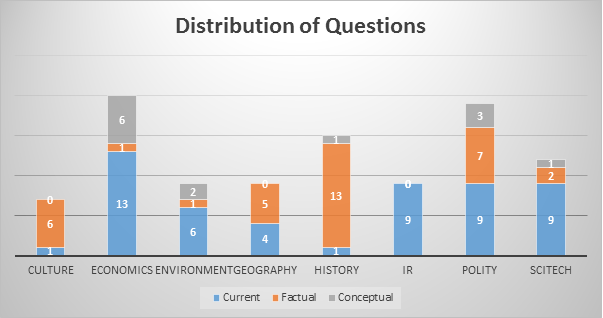
Culture: 7 questions, all were factual except Sujni and Uppada. 2 religion based questions were on expected lines. 2 were on Heritage and traditions which are difficult parts to pick from news. Both Arts based questions were very specific. One was from Architecture which is again vast area. Culture was tough this year with 2 questions more than last year.
Economics: 20 questions!! 7 more than last year. Which means this year Economics can be the make or break section. Variety of areas were covered with special emphasis on Monetary policy (7 questions). Agri Economics, Basic Economics, Development and Survey-Budget had 2 questions each. 13 questions were current based while 6 were conceptual and 1 was factual. Conceptual questions were all known but needed in depth analysis for attempting them. Digital economics was at the forefront this year. Overall I will rate Economics as comfortable as compared to last year, and also as compared to the overall difficulty level of the paper.
Environment: 9 questions- 4 less than last year. As expected Climate change and Institutions had more share of 3 each. 6 questions were current based with 2 conceptual and a single factual question. Current based questions were not from prominent coverage and hence on a tougher side. Environment was definitely tougher than last Prelims.
Geography: 9 questions- 5 factual and 4 based on current affairs- with no conceptual one. Last year Prelims had 6 map based questions which came down to 1 this year. Indian Physiography and Agriculture were having 2 questions each. Hardness level was above average.
History: History had more weightage this year. Out of 15, 12 questions were from Modern India while 2 were from Post Independence history. To relief of many there was 1 question from Medieval era and none from Ancient History. Except Champaran Satyagraha (based on Current) and Subsidiary alliance (concept checking), all were factual questions ranging from easy to very tough. Focus was on British education policy and trade. Due to such distribution of questions, History was quite tough and tricky.
International Relations: 9 questions- all from the current affairs! As expected Geopolitics and International institutions dominated the IR section, along with a single question about Developmental dynamics. For someone well versed with the current affairs, IR should have been relatively the easiest section this year. In absolute terms, it was average in hardness.
Polity: A critical component of Prelims, Polity had its fair share of 19 questions. Schemes (6 questions) and Parliament (4 questions) together dominated the section. Other questions were from Constitution, Executive, Legislations and Political theory. 9 current based, 7 factual and 3 conceptual questions made it a mixed bag. Polity this year demanded a very sound understanding of the basics. Hence it was above average in hardness.
Science and Technology: 12 questions. Except 2 factual and one conceptual, rest 9 were current affairs based. ICT and IT dominated with 5 questions together. 2 questions were from Space and Basic science. Advanced Physics is the new focus area for UPSC. Overall this section was on easier side considering the vast and ever expanding arena.


Section wise and Type wise analysis
Looking back at the entire GS paper, 52 questions were factual- same as 2017. But the number of conceptual questions came down from 21 to 13. This meant there was an increase in the number of factual questions: 27 to 35 this year. 35 factual questions certainly increased the specificity of the paper, thereby increasing the hardness level.
Now coming to the key question- Was this the toughest Prelims GS paper in recent times? Partially yes. It was certainly the toughest since CSAT arrived (2011). But dissecting the toughness, we can point out three major reasons. One, sizeable number of the factual questions were very specific as discussed earlier (e.g. Bani Thani painting- No logical elimination possible). This means you either know the answer or you don’t. This decreases the possibility for logical elimination. This factor has brought down the average attempt this year. Now to tackle such questions, we really need to increase the depth of study. Even after doing this, there will be questions which are simply unsolvable, coming out of the wild. So in these type of scenarios, we must prepare thoroughly and attempt the questions positively- as much as we can.
Secondly, the current affairs based questions were from news which were not really prominently highlighted by media (e,g, Baigas march did not get footage like Kisan march of Maharashtra). Other current affairs based questions tested the detailing and depth of background knowledge. (e.g. ASEAN completed 50 years but the question was on its FTA partnerships) So this means we must improve our study of current affairs. I have talked with more than hundred candidates who admitted that they found the paper tough because they did not study the news thoroughly. I would suggest everyone who feels the same to revisit their current affairs preparation strategy. My article https://abhijitraut10.wordpress.com/2014/09/10/current-affairs/ is there to help you. Current affairs is THE MOST IMPORTANT part of your Civil Services preparation. Never neglect Newspaper reading- even if it taker 3-4 hours daily. Further the readymade current affairs material can only be supplementary. Real study can be done only by detailed newspaper reading. There is no shortcut to this!
Lastly, due to the above two reasons, many candidates fumbled by attempting the first round extra cautiously, thereby leading to less attempt and more time spent in the first round itself. This created extra pressure on second round leading to many silly mistakes. In such tough papers, I would advise to stop lingering on tough questions in first round. Attempt the easier ones and save time for second round where we are more settled and less anxious.
Looking ahead, I would reckon this year cut-off will go below 100. My guess would be 95-97. So anyone having score above 90 by any key should positively start for Mains because any key you check has an error margin of 2-3 questions. And a margin of even one question means a difference 2 marks each of correct answer and 0.67 mark each which you saved from negative marking. So the error margin is straight away 5.5 to 8 marks. While studying for Mains, focus on basics and trending issues. Study news thoroughly and write as much as you can. Prepare hard enough to be ready to face any surprise that UPSC throws and perform like a champion. All the best!!
 Expressions and Impressions
Very precise and pathfinder analysis of prelim Da … thank you so much
LikeLiked by 1 person
Very well analyzed, Thanks!
LikeLiked by 1 person
https://globalknowledge2.wordpress.com
LikeLike
Fine analysis, pin point specific, detailed and well written in simple language. Definitely will help many aspirants. Keep writing, will love to read more from you !
LikeLike