The Eisenhower Matrix is a simple decision-making tool that helps you make the distinction between tasks that are important, not important, urgent, and not urgent. It splits tasks into four boxes that prioritize which tasks you should focus on first and which you should delegate or delete.
The strategy for taking action and organizing your tasks is simple. Using the decision matrix, you will separate your actions based on four possibilities. This will allow you to categorize your to-do items into one of four possible descriptions:
First Quadrant (Upper Left): Urgent and Important
Second Quadrant (Upper Right): Important, but not Urgent
Third Quadrant (Lower Left): Not Important, but Urgent
Fourth Quadrant (Lower Right): Neither Important nor Urgent
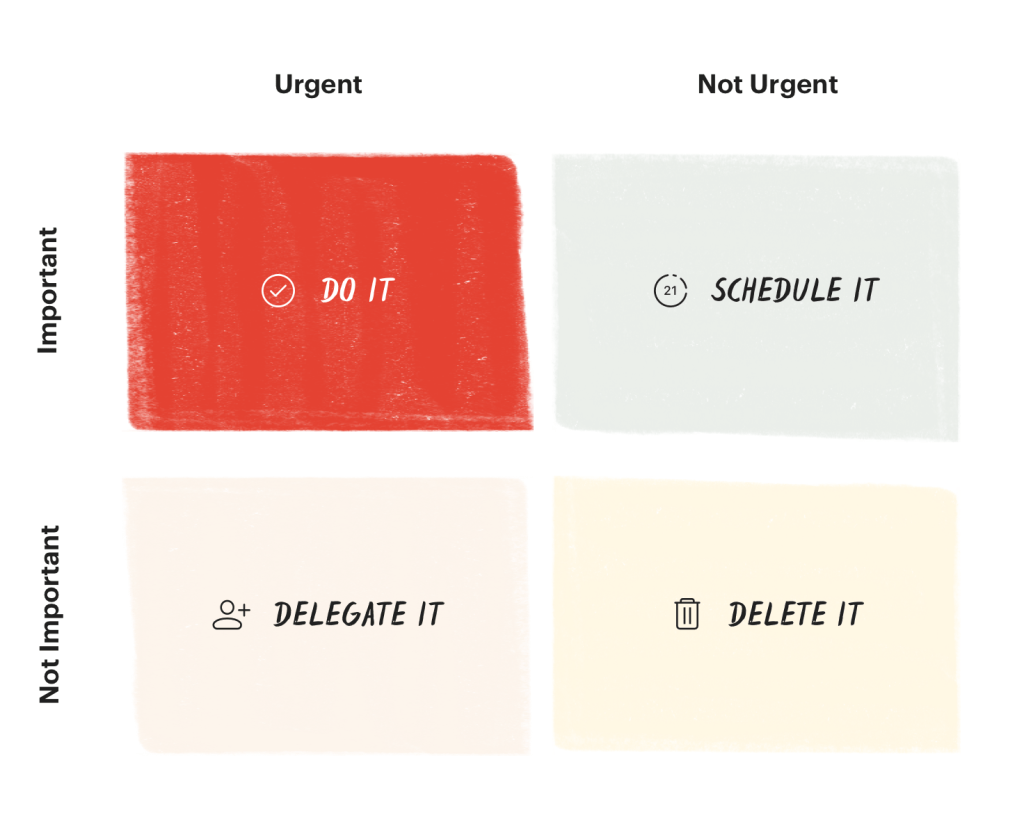
A. Do the tasks in quadrant 1.
These are the items that are both urgent and important, and they, therefore, demand your action right away.
B. Decide on when to deal with the tasks in quadrant 2.
These are essential issues, but they’re not urgent and therefore don’t require your immediate action. So these are the items you’ll want to schedule work for a later time.
C. Delegate the tasks in quadrant 3.
These are urgent items that pop up and demand immediate attention. But because they’re not necessary, they don’t necessarily require your time, and they can, therefore, assign them to someone else.
D. Delete the items in quadrant 4.
These items in your Eisenhower Matrix are not essential or urgent, so you can, in most cases, erase them from your list.
Following time management tips will be helpful when working with the Eisenhower Matrix:
1. Putting things to-do on a list frees your mind. But always question what is worth doing first.
2. Try limiting yourself to a reasonable number of tasks per quadrant. Before adding another one, complete the most important one first. Remember: It is not about collecting but finishing tasks.
3. You should always maintain only one list for both business and private tasks. That way you will never be able to complain about not having done anything for your family or yourself at the end of the day.
4. Do not let you or others distract you. Do not let others define your priority. Plan in the morning, then work on your stuff. And in the end, enjoy the feeling of completion.
5. Finally, try not to procrastinate that much. Not even by over-managing your to-dos.
Ref.: https://www.eisenhower.me, www.productplan.com, www.slab.com, https://todoist.com
 Expressions and Impressions
Quite helpful in effective and efficient time management.
LikeLike