The Pareto Principle, also called as 80:20 Principle states that 20 percent of your activities will account for 80 percent of your results. However, it is not a hard and fast mathematical law. It is a concept. The key to following the 80 20 rule is to identify that roughly 20 percent of your actions or most productive tasks lead to the most success. This can apply to any area of your professional and personal life. Simply put, the Pareto Principle helps you determine which areas to focus your efforts on.
When you understand that the vast majority of your results are being driven by a small percentage of your efforts, you can pinpoint which efforts are driving the most results in your business and life; and focus your energy on those. The most valuable tasks you can do each day are often the hardest and most complex, but the payoff and rewards for completing them can be tremendous, according to the Pareto analysis. If you choose to start your day working on high-value tasks, you will soon develop the habit of always starting and working on high-value tasks.
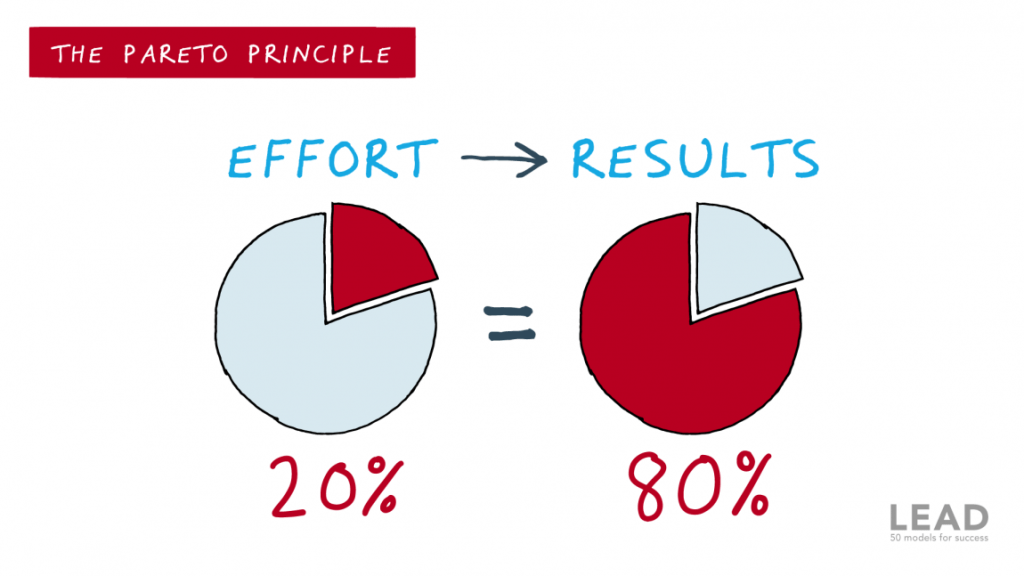
The basic algorithm of Pareto Principle is as follows:
- Track activities/tasks.
First of all, you need to track and analyze the activities and tasks you perform in order to achieve the desired outcome. By doing this you will find out how activities/tasks actually contribute to the outcome.
2. Find out the key activities/tasks
Next you need to mark the key activities/tasks, which contribute largely in achieving the outcome. These maybe the hardest or the most demanding issues.
3. Focus on these key issues (the majors)
Now you have to focus on these key issues so as to maximize the output. You can rethink about the way you do them, or make other changes in strategies such as when to perform these key issues, whom to assign these issues etc.
4. Strategize about remaining activities/tasks
Once you are done with the key issues (the majors), you can subsequently work out the strategy to perform the remaining ones (the minors). You may delegate/outsource them or plan them so as to save time, energy and resources.
Pareto Principle is of immense use as it gives insight into the causes and effects of your productivity routines. You learn more about where to best allocate efforts for maximum results. You can restructure your workday or workweek to better match your max-productivity output days and hours. The 80 20 principle helps you decide which resources are the most important for you to use to achieve the greatest efficiency. It helps reduce wasting time, money, supplies, efforts, emotions, energy, and so on.
On the flip side, some systems might not follow the Pareto Principle. In some sectors, this principle maybe applicable partially. Further, the classification of majors and minors can be dynamic and may change with context. However if the basic strategy is framed perfectly, Pareto Principle can be a massive booster to productivity.
 Expressions and Impressions
Sir,good article but please put up with example,
Means how can we track activities and is it possible to track it on daily basis?
LikeLike