Limitless (Hay House Inc.) covers the story of how Jim Kwik taught himself to learn again after he hit his head and suffered a brain injury. At the heart of Kwik’s mental transformation is a simple truth: We all can mold our brains and continuously improve our mental abilities. If you’re struggling to learn, it’s not due to an innate brain limitation. Your struggles with learning are due to either a limited mindset, limited motivation, or a lousy learning method.
The underlying concept of Limitless is that human potential is the only truly infinite resource in the world, and any limits we have are self-imposed. To achieve more, remove the limits in your mindset, your motivation, and the methods you use. Remove those limits, or install expanded and better systems or operating software, and you can tap into the superpowers that you already have. This book really makes you think about what you’re capable of achieving. It challenges you to reach for the stars, and to become limitless as the title suggests.
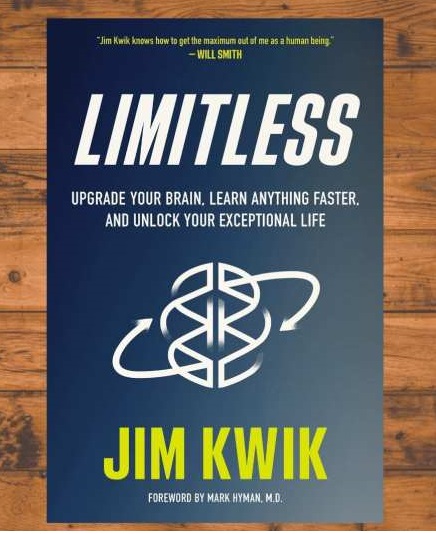
Pic: http://www.biznessprofessionals.com
Highlights:
1. FASTER Technique
F- Forget – In order to focus on a task, you need to remove or forget the potential distractions surrounding you.
A- Act – Your brain does not learn as much by consumption as it does by creation. You need to discard passive education and start acting on what you learn.
S- State – Your learning is directly related to the state you are in at that time. This includes both your psychological state and your physiological state.
T- Teach – Learn with the intention of teaching this information to someone else. By this way, you will learn with the intention of mastering it.
E- Enter – Apart from entering important tasks in the schedule, also enter the opportunities for personal growth and development.
R- Review – It is our natural tendency to forget information in a short amount of time if we don’t actively try to remember it. To limit the impact of the forgetting curve, you should actively review and recall what you’ve learned by using spaced repetition. Spaced repetition requires you to practice new and difficult information more frequently than older and less difficult information.
2. 3 Ms
There are three limits which need to be removed:
●Mindset (the What)- incorrect beliefs, attitudes or assumptions.
●Motivation (the Why)- lack of drive, purpose, or energy to behave in a more limitless manner.
● Methods (the How)- incorrect processes which will not generate the results you want.
3. The 4-3-2-1 method
By merely entertaining the idea that your reading speed potential is limitless, you can noticeably increase your reading speed. It is demonstrated by the ten-minute exercise called the 4-3-2-1 method. Set a timer for four minutes and open an easy-to-read book. Start reading at a comfortable pace while using your finger to underline the words as you read them. When the four-minute timer expires, mark the point at which you stopped. Now go back to where you started and set a timer for three minutes. Try to get to that same point you reached after four minutes. When the three-minute timer expires, do the same for two minutes, and then one minute. After this 4, 3, 2, 1 exercise, resume reading the rest of the book at a comfortable speed for four minutes. If you compare the number of lines you read now, you will be pleasantly surprised by how much faster you can read.
4. Effective Reading
Assume that every book you read contains a profound insight. For example, imagine that someone else has just paid ten million dollars for the information you are about to read. With that mental framing, you will become extremely curious and motivated to absorb the information. After you’ve generated ample motivation, it’s time to upgrade your reading methods.
5. Effective Questions
For staying motivated, ask yourself the following questions:
● How connected do I feel to my purpose?
● How are my day-to-day energy levels?
● What am I allowing to drain my energy that I no longer should?
Based on these points, Kwik devised a simple equation
Motivation = Purpose x Energy x Small Simple Steps
6. Improve focus by changing Environment
Productivity can be improved using simple hacks:
● Designate work-only zones.
● Set the appropriate soundtrack. Set the same playlist whenever you do a specific task and choose playlists that fit the task.
● Give your devices specific tasks. Our brain doesn’t know the difference between the real world and the digital world. We should use a personal phone and work phone, a personal laptop and work laptop.
7. Avoid regression and subvocalization
Regression means going back to reread same lines. To solve this problem problem, you need to use a pacer. Attention follows movement. If you use your finger to guide your reading, you prevent your attention from jumping around the text. Many people have low reading comprehension because reading is too slow and boring for them. But you can get your brain’s attention by moving your pacer more quickly. When you move your finger at a pace that’s on the edge of your perceived maximum reading speed, you require your full attention. More attention equals more retention.
Subvocalization is the habit of saying the words to yourself in your head as you read. When you feel the need to sound out every word you read, your reading speed is limited by how fast you can talk.
8. Avoid 4Ds
In an increasingly digitalizing world, following factors should be avoided for being limitless:
● Digital Deluge – We consume significantly more data now in one day than a person centuries ago would have in their entire lifetime. This can leave our brain overwhelmed.
● Digital Distraction – Instead of relaxing into our time, we often pull our phones out. This ultimately trains our distraction muscles.
● Digital Dementia – Over-reliance on technology could lead to us no longer honing our cognitive abilities. We should look at our brains more like a muscle rather than a hard drive.
● Digital Deduction – The automation of critical thinking and problem-solving makes us much worse at these skills, but we will always need these skills in life.
Courtesy:
 Expressions and Impressions
Thank you Sir for putting one whole book in few words
LikeLiked by 1 person