In Essentialism (Penguin Random House), Greg McKeown draws on experience and insight from working with the leaders of the most innovative companies in the world to show how to achieve the disciplined pursuit of less. Greg McKeown proposes a somewhat radical approach: eliminate most and pursue few. The Way of the Essentialist involves doing less, but better, so you can make the highest possible contribution.
Essentialism isn’t one more thing; it is a different way of doing everything. It is a discipline you apply constantly, effortlessly. Essentialism is a mindset; a way of life. It’s about regaining control of our own choices about where to spend our time and energies instead of giving others implicit permission to choose for us.
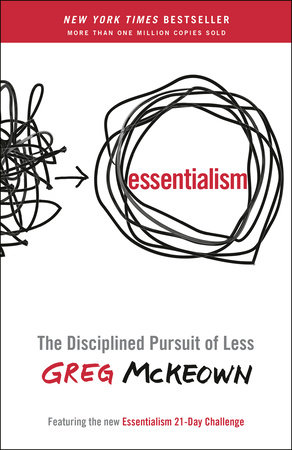
Pic: http://www.penguinrandomhouse.com
Highlights:
- The Essentialist
The Essentialist consciously differentiates the vital few from the trivial many. This helps to eliminate the non-essentials, and then to overcome hurdles to make sure that the essential things have clear, smooth passage. An Essentialist dismisses the idea of living by default, and instead chooses living by design.
Essentialism helps to deal with the Paradox of Success; wherein success opens up new options and opportunities, which in turn leads to diffused efforts and diminished productivity. The relentless pursuit of success can distract us from focusing on what is essential, which may result in failure.
- Choose
To become an Essentialist requires a heightened awareness of our ability to choose. While we may not always have control over our options, we always have control over how we choose among them.
- Discern
We live in a world which is cluttered with many things that are worthless (noise), with very few things being precious (signal). Essentialism requires discerning what is essential from what is trivial.
- Trade-off
Trade-off the choice that involves losing opportunities in return for the gains of another one. Saying yes to any opportunity by definition requires saying no to several others. Instead of asking, ‘What do I have to give up?’ ask, ‘What do I want to go big on?’
- Escape
We need space to escape in order to discern the essential few from the non-essential stuff. You need to make daily space to escape your busy life to focus and work on design, concentration and knowledge. Being unavailable for sometime is good if you work on yourself.
- Look
Essentialism requires you to be an intentional observer and listener in order to focus on the signal in the noise, to hear what is not being discussed, and to filter to find the essential information. Being a journalist of your own life will force you to stop hyper-focusing on all the minor details and see what really matters.
- Play
An Essentialist knows that play is essential, resulting in creativity, growth, and exploration. Embracing the wisdom of your inner child helps you to broaden the canvas, stimulate cognitive abilities and relieve from stress.
- Sleep
The best asset we have for making a contribution to the world is ourselves. You need to protect this asset. Rest is necessary for operating at high levels of contribution. Our highest priority should be to protect our ability to prioritize, by ensuring one’s own well-being.
- Select
We should be more selective and remember- “if it isn’t a clear yes, then it’s a clear no.” While evaluating an option or criterion for a decision on a scale from 0 to 100, if you score it lower than 90%, you should reject it. You need to evaluate the opportunities using minimum criteria and extreme criteria.
- Clarify
Lack of clarity leads to confusion, stress, and frustration. Clarity can be achieved by determining our essential intent; i.e. one decision that eliminates a thousand later decisions which are essential, inspirational and intentional.
- Dare
A graceful ‘No’ is one of the most powerful things. We need to separate the decision from the relationship so as to make a clear decision, and then separately find the courage and compassion to communicate it.
- Uncommit
In an overwhelming world, you need to maximize your wins by cutting down your losses. One has to overcome the Sunk-cost Bias i.e. the tendency to continue to invest time, money, or energy into something we know is a losing proposition simply because we have already incurred, or sunk, a cost that cannot be recouped. You have to avoid the commitment traps by addressing the endowment effect and thinking rationally.
- Edit
Editing helps you focus on and contribute to what matters through subtraction. An Editor ensures two things- Are you doing/saying what you want to do/say? and, Are you doing/saying it as clearly and concisely as possible?
References:
 Expressions and Impressions
👍🏻
LikeLiked by 1 person