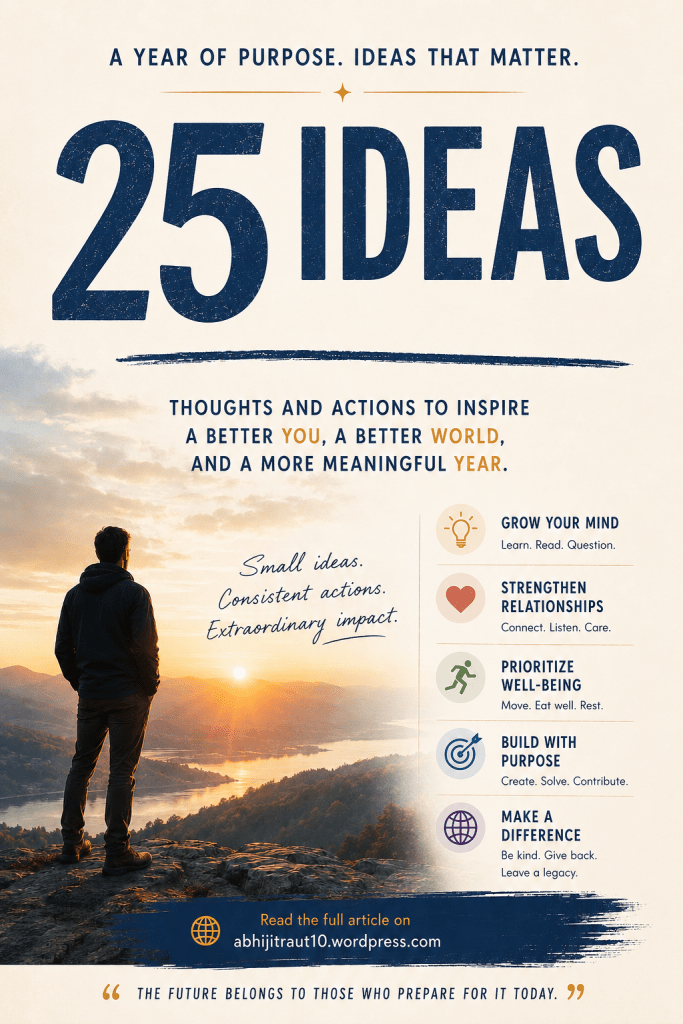
It’s the last weekend of this year and soon we will be entering 2025. Almost a quarter of this century has gone by and humanity has taken new leaps in this period, making the world move at a breakneck speed. In today’s world, we need to focus on Well-being: Both personal and professional. So here is an attempt to share 25 amusing and effective ideas for the upcoming year 2025 which will help to change your view and achieve well-being.
Source: Twitter/X posts of @SahilBloom. Follow this handle for many such life changing ideas.

1. Visualizing Time
Family time is limited—cherish it.
Friend time is limited—prioritize real ones.
Partner time is significant—never settle.
Children time is precious—be present.
Coworker time is significant—find energy.
Alone time is highest—love yourself.
2. Darkest Hour Friends
Most of your friends aren’t really your friends. They‘re just along for the ride when it’s fun or valuable.
The real ones are there for you when it’s neither—there for you in your darkest hour.
Treasure your Darkest Hour Friends.
Be one to someone else.
3. The Two-Day Rule
How to make new habits stick:
With whatever habit you’re trying to build, never allow yourself to skip more than one day in a row.
This creates forward progress—but allows for the vagaries of life to enter without derailing momentum.
4. The Surfer Mentality
When a surfer gets up on a wave, they enjoy the moment, even though they know the wave will eventually end (and maybe crash on them).
They enjoy the ride—knowing that there are always more waves coming.
This is a powerful mentality for riding the waves of life.
5. Give Them Their Flowers
When you think something nice about someone, let them know.
It’s a shame that we often wait until a person’s departure to say all of the nice things we thought about them.
The next time you have a positive thought about someone—tell them right then.
6. Time Billionaire
Time is our most precious asset.
When you’re young, you are a “Time Billionaire”—literally rich with time.
Too many fail to realize the value of this asset until it is gone.
Treat time as your ultimate currency—it’s all you have and you can never get it back.
7. Engineered Serendipity
Some of what we call “luck” is actually the macro result of thousands of micro actions.
Your daily habits can put you in a position where “luck” is more likely to strike.
It’s possible to increase your serendipity surface area and engineer your own luck.
8.Free Time as an Asset
The idea that free time is bad is one of the greatest lies you’ve been told.
The reality is: Free time is a call option on future interesting opportunities.
When you have free time, you have the headspace and bandwidth to pursue high-upside ideas. You need to use that wisely.
9. Move for the Brain
Researchers studied the effects of a walk on the cognitive performance of a group of children.
Reading comprehension was significantly better after exercise. Spelling and arithmetic were modestly better.
Recess is sacred—for children and adults alike!
10. Work Like a Lion
Parkinson’s Law says that work expands to fill the time available for its completion.
When you establish fixed hours to work, you’ll find unproductive ways to fill it.
Work longer, get less done.
Work like a lion instead—wait, sprint, rest, repeat.
11. Relationship Matrix
Every relationship exists on a 2×2 matrix of:
- How healthy it is
- How enjoyable it is
Best relationships are healthy & enjoyable.
Focus on spending more energy on your these relationships—cherish them.
Scrub the first relationships- unhealthy and unenjoyable from your life.
12. The Eisenhower Matrix
Learn the difference between important and urgent.
Place tasks on a 2×2 matrix:
• Important & Urgent
• Important & Not Urgent
• Not Important & Urgent
• Not Important & Not Urgent
Prioritize, delegate, or delete accordingly.
13. The Paradox of Advice
Taking more advice leaves you less well-equipped.
Most advice actually hurts.
It’s well-intentioned, but it’s dangerous to use someone else’s map of reality to navigate yours.
Winners learn to filter and selectively implement—take the signal, skip the noise.
14. The Parent Interview
Record a video interview with your parents.
Ask them to tell stories about their childhood, adventures, dreams, and fears.
Our time with them is finite—but we often fail to recognize it until it’s too late.
The experience and recordings will last forever.
15. The Paradox of Effort
You have to put in more effort to make something appear effortless.
Effortless, elegant performances are often just the result of a large volume of effortful, gritty practice.
Small things become big things. Simple is not simple.
16. Paths Open vs Closed
We spend too much time focusing on what might have been and not enough time focusing on what may be.
Never underestimate the density of opportunity that lies ahead.
17. The Spotlight Effect
Most people don’t really care about you.
The Spotlight Effect says that we overestimate the degree to which other people are noticing our actions.
This is liberating—stop worrying about what others think, be yourself, and live according to your values.
18. Intellectual Sparring Partners
Most of us need fewer friends and more intellectual sparring partners.
Friends are easy to come by. Intellectual sparring partners are harder to find.
They will call you on your mistakes, question your assumptions, and push you to think deeply.
19. The Regret Minimization Framework
The goal is to minimize the number of regrets in life.
When faced with a tough decision:
• Project into the future
• Look back on the decision
• Ask “Will I regret not doing this?”
• Act accordingly.
Regret is more painful than failure.
20. Next move matters the most.
The only move that matters is the next move.
Most people waste energy on:
• Past Moves—what could have been
• Future Moves—what might become
The only move that matters is the next move.
Don’t waste energy on the past or the distant future—focus in the present.
21. The Paradox of Speed
You have to slow down to speed up.
The benefits of slowing down are extensive:
• Be more deliberate with direction
• Focus on highest leverage opportunities
• Restore your energy
• Notice things you previously missed
Move slow to move fast.
22. 30 for 30 Method
If you want to improve something, there is a method that consistently works: 30-for-30 Approach.
Do the thing you’re trying to improve at:
• 30 minutes per day
• 30 straight days
It works for 3 simple reasons:
Commitment
Low intimidation
Compounding
23. Spaced Recognition Method
Spaced Repetition leverages cognitive science to help you retain new information.
It plays on the way our brains work to convert short-term to long-term memory.
With Spaced Repetition, information is consumed at increasing intervals until it’s committed to long-term memory.
24. Pass the Plane Test
There’s a common—and dated—test for selecting a person for some specific job.
“Would I want to sit next to this person on a plane for 6 hours?”
Be yourself, but be sure to get across that you’re kind and genuine. Everyone likes a warm, positive yet non-intrusive personality.
25. Process over outcomes.
When we focus on outcomes, endpoints, and goals, we are playing finite games.
We set ourselves up for the disappointment that follows a miss—because we failed to hit the target—or a success—because it’s not what we expected.
When we focus on process, we are playing infinite games.
Those who play infinite games will always win in the long run.
Happy New Year!!
Follow me on
X/Twitter http://www.x.com/abhijitraut10
Facebook http://www.facebook.com/abhijitraut10
Instagram http://www.instagram.com/abhijitraut10
 Expressions and Impressions
It give immense positive energy to enter in the next year with a warm hopes and wills with attractive outcome
LikeLiked by 1 person
To Abhijit!! I wish you happy new year and thank you for this beautiful article. May god bless you.
LikeLiked by 1 person
It was a wonderful article. Thank you so much.
LikeLiked by 1 person
Very nice and Positivity filled ideas sir…! Surely some great inputs for 2025 for us. 😊
-Sumit
LikeLiked by 1 person
Simplicity in expression of these important life lessons showcase the years of experience behind these learnings….
Happy New Year Sir 🎉💐
LikeLiked by 1 person
I greatly enjoyed this inspiring list. I am printing it out to savour for the New Year, and share with others.
LikeLiked by 1 person
Hello, Abhijit like this article , I am sharing your article in my e-magazine “SHABD”cover on LinkedIn
if any issue you have plz connect me over there
https://www.linkedin.com/in/chhayajha12
LikeLiked by 1 person
Thank you for sharing. Pl mention original creator Sahil Bloom in credits
LikeLike
One of the finest write-ups I came across in recent times!Thanks to Sahil Bloom.. and to you for this much needed compilation.
LikeLiked by 1 person
Also please share other posts if you feel they are worth sharing
LikeLike
A good collection of profound thoughts. Thank you for sharing 🙏
LikeLiked by 1 person
nice post. Click Here
LikeLiked by 1 person
Thank You So Much 🙏🙏 – Anonymous
LikeLiked by 1 person
golden words
LikeLiked by 1 person
4 and 5 definitely hit
LikeLiked by 1 person
Thank you sir for sharing such precious thoughts…
Nandkumar walekar
LikeLiked by 1 person
Thanks a lot for sharing such thoughts for 2025. I I will definitely apply them.
LikeLiked by 1 person
great words of wisdom… thank you
LikeLiked by 1 person
Thanks for sharing your wise thoughts Sir.
LikeLiked by 1 person
Thanks for sharing your wise thought sir.
LikeLiked by 1 person