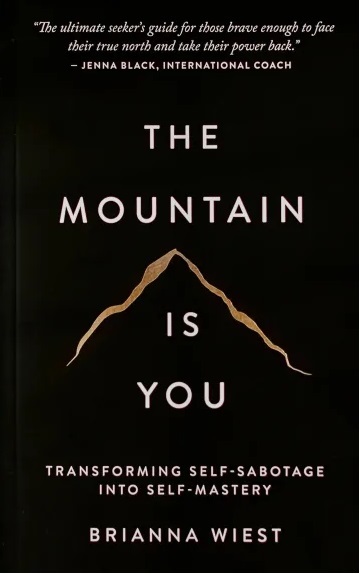
“The Mountain Is You” by Brianna Wiest is a powerful guide to self-transformation, centered around the idea that our greatest challenges are often internal. Through thoughtful insights and practical wisdom, Wiest explores how self-sabotage, fear, and unresolved emotions can block us from becoming our best selves. Using the metaphor of climbing a mountain, she illustrates that the journey of personal growth is not about conquering the outside world, but about facing and overcoming the deepest parts of ourselves. This book is a call to awaken, take ownership of our healing, and become the person we are truly meant to be.
Highlights
Understand your inner mountain
Not every difficulty is self-created, but our beliefs, fears and habits can keep us stuck in recurring problems. Growth begins by recognising the patterns we can change and taking responsibility for our response.
Self-sabotage serves a hidden need
Behaviours that hold us back often protect us from something we fear. Procrastination may shield us from judgement, while avoiding relationships may protect us from rejection. Lasting change requires understanding the need beneath the behaviour and finding a healthier way to meet it.
The familiar is not always healthy
We often choose what feels familiar, even when it makes us unhappy. Peace, success or a stable relationship can feel uncomfortable when we are accustomed to struggle. Sometimes growth means allowing a better life to gradually become our new normal.
Your triggers reveal what needs attention
Strong emotional reactions can offer clues about unresolved experiences, unmet needs or boundaries we have not expressed. Instead of condemning the reaction, ask what it reveals. Understanding a trigger gives us more freedom to choose our response.
Your emotions offer information
Feelings deserve attention, but they do not have to determine our actions. We can acknowledge anger without lashing out, experience fear without abandoning an opportunity, and feel sadness without judging ourselves. Self-mastery grows through this space between feeling and action.
Question the stories your mind creates
An anxious prediction can feel convincing without being true. One setback does not establish a pattern of permanent failure, and uncertainty does not prove that something terrible will happen. Separate what you know from what you assume, then respond to the situation before you.
Small shifts create lasting change
Transformation develops through small actions repeated consistently. Keeping a promise, setting a boundary or responding differently to a familiar difficulty gradually changes how we live. Progress becomes sustainable when new behaviour becomes part of ordinary life.
Release the past by building the present
Letting go involves accepting that an experience cannot be given a different ending. We can acknowledge what happened, understand what we needed and begin meeting those needs in the present. The past loosens its hold as we create a life beyond it.
Allow your identity to evolve
An old ambition, relationship or image of success may no longer fit who we are becoming. Growth requires honestly reassessing what we want and releasing roles we maintain only through habit, pride or approval. We are allowed to change direction.
Build your life on principles
Motivation rises and falls, while principles provide steadier direction. Honesty, responsibility, self-respect and care for our well-being can guide decisions even on difficult days. The future takes shape through the choices we repeatedly make.
Rebuild self-trust through action
Confidence grows when we follow through, honour our needs and recover after mistakes. We do not need to believe that we will always make the right decision. We need to know that we can face reality, seek help and adjust our course.
Make room for peace and enjoyment
A meaningful life includes rest, relationships, curiosity and ordinary pleasures. Constantly trying to improve ourselves can make us overlook the life already available to us. Growth also means learning to be present and allowing ourselves to enjoy the journey.


nicely said 🙏🙏🙏💐
LikeLiked by 1 person
nicely said 🙏🙏🙏
LikeLiked by 1 person