Turning Ideas Into Impact
Strategic thinking is the ability to see the bigger picture while making smart decisions in the present. It’s not just about solving problems — it’s about solving the right problems, in the right way, with a clear direction in mind. Strategic thinkers don’t react blindly; they pause, analyze, prioritize, and act with purpose.
Why is Strategic Thinking important? In a fast-moving world filled with constant change, strategic thinking helps you stay ahead instead of falling behind. It improves clarity, sharpens decision-making, strengthens communication, and builds confidence. Whether you’re leading a team, running a business, or managing your personal goals, strategic thinking helps you move from chaos to clarity and from effort to impact.
This article explores the Seven-Step Strategic Thinking Method that transforms complex problems into clear action.
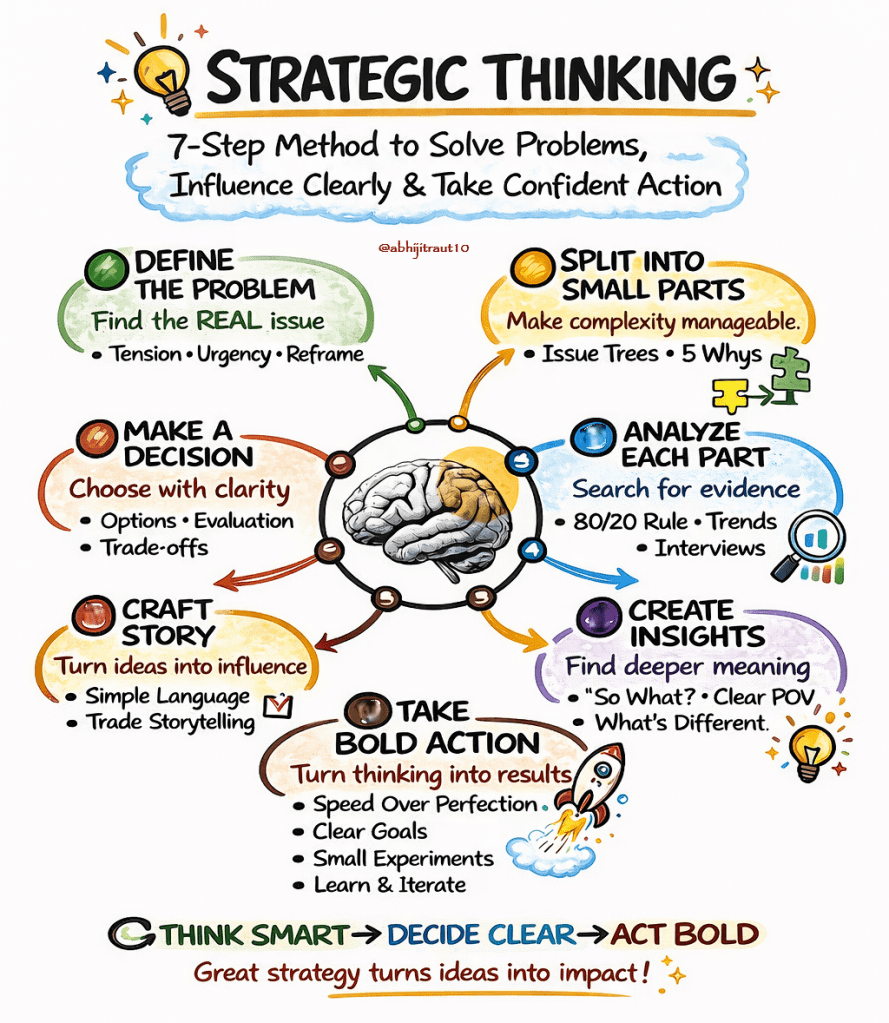
1. Define the Problem Clearly
Every strong strategy starts with the right question. Often, what we think is the problem is only a symptom. Strategic thinkers dig deeper to identify the real issue.
Ask yourself:
What exactly isn’t working?
Why does it matter?
How urgent is it?
Sometimes reframing the problem reveals better solutions. When you define the problem accurately, you set the foundation for everything that follows.
2. Break the Problem Into Smaller Parts
Big problems feel overwhelming because they appear complex. The solution? Break them down.
Use tools like issue trees or the “5 Whys” technique to identify root causes. When a problem is divided into smaller pieces, it becomes easier to understand, analyze, and solve. Clarity replaces confusion.
3. Analyze Each Part Thoroughly
This is where evidence meets logic. Instead of relying on assumptions, investigate.
Look for patterns and trends. Apply frameworks like the 80/20 rule to identify what truly drives results. Speak to people who are closest to the problem. Strategic analysis helps you focus on what actually moves the needle rather than wasting energy on distractions.
4. Create Meaningful Insights
Data alone doesn’t create value — insights do.
At this stage, ask the powerful question: “So what?”
What is surprising? What stands out? What really matters?
Strong insights help you form a clear point of view and transform raw information into practical understanding. This is where strategy begins to take shape.
5. Craft a Compelling Story
A strategy that can’t be explained clearly rarely gets implemented successfully.
Turn your ideas into a simple, persuasive narrative. A good story explains the problem, the solution, and the path forward. Use clear language and visuals when possible. When people understand the “why” and “how,” they are far more likely to support and act on your plan.
6. Make the Decision With Confidence
Strategic thinking is not about endless analysis — it’s about making smart choices.
List your options clearly and evaluate them using defined criteria. Understand the trade-offs. No decision is perfect, but informed decisions create momentum. At this stage, clarity beats perfection.
7. Take Bold Action
The final step is where strategy becomes reality.
Move fast rather than waiting for perfection. Start with small experiments, learn quickly, and improve through iteration. Align people with clear goals and maintain focus on execution. Remember — thinking only matters when it leads to action.
Strategy is a mindset, not just a method. Strategic thinking is not reserved for boardrooms or CEOs. It’s a daily skill that helps you think smarter, act faster, and create better outcomes.
When you define clearly, analyze deeply, decide wisely, and act boldly, you don’t just solve problems. You shape the future instead of reacting to it. Because eventually, great strategy isn’t about having more ideas. It’s about making the right moves at the right time.
 Expressions and Impressions
Leave a comment