UPSC prelims returned back to tougher levels to a great extent in 2025. But 2026 Prelims was several notches higher than any of the recent years. Loads of direct factual questions, focus on new arenas, time-consuming application questions made it challenging, especially in the exam hall pressure. In a welcome move UPSC has also released the answer key. Aspirants must have calculated their score and started preparing accordingly. However it is still important to analyse this Prelims paper for three reasons:
1. To understand the exact nature of questions and the source.
2. To get a guessing about how UPSC is changing the pattern of questions in view of coming Mains and next Prelims.
3. To demystify Prelims to the extent possible and to understand that except a few, all questions come for a reason.
It is right time to analyze what went wrong for candidates getting low scores, and to understand where UPSC is moving with its questions for candidates getting the opportunity to write Mains. So here is my attempt to dissect the pattern of Prelims 2026 Question paper. Friends keep in mind the categorization of the questions is a subjective matter and can vary person to person.
Question paper Set A
No. Keyword/ Subject/ Topic/ Type
Comment.
- Raga Bilawal/ Cul/Arts/Factual
Very typical old-school pre-CSAT era factual question: you know it or you don’t. No elimination possible unless one knows Hindustani–Carnatic mapping. UPSC seems to be reviving direct art-and-culture memory check. (Trivia: Our National Anthem is in Raga Bilawal.)
2. Hilton Young Commission/ His/Modern/Factual
Interesting and slightly unconventional. Most aspirants focus on political reforms while economic administration under British rule gets ignored. Hidden lesson: institutions and commissions matter.
3. Pali texts/Cul/ Literature/Factual
Another very to the point factual question from Culture. It also has link with history of monetary system. Classic UPSC move: connect literature with economy.
4. Nagara style shikhara/ Cul/Architecture/Current
Pattadakal was in news for the renovation and restoration initiative taken by ASI.
5. Jainism/ Cul/Religion/Factual
To the point factual bit. Such questions usually come from one-line NCERT or standard culture compilations.
6. Hallisalasya painting/ Cul/Architecture/Factual
Another to the point factual question. Bagh Caves often remain overshadowed by Ajanta Ellora, and UPSC has often tested depth rather than popularity.
7. Inscriptions/ Cul/Architecture/Factual
Factual question but not a direct recall type. Rather it tests chronology, inscriptions and transmission of mathematical ideas.
8. Harappan towns/ His/Ancient/Factual
Factual question with analytical orientation which requires converting archaeological evidence into social inference. Less memory, more historical reasoning.
9. Eka movement Bardoli satyagraha/ His/Modern/Factual
This question tests knowledge about two events. UPSC has moved beyond isolated movement questions and tested comparison. Candidates who focus on context rather than lists would gain advantage.
10. Rigvedic period/ His/Ancient/Factual
Another multi-dimensional question testing History, Economy and Technology. Again its about contextual understanding rather than memory.
11. River flow in Pleistocene period/ Geog/Physical/Factual
Tough question which tests river evolution and paleo-geography. A reminder that geography can become conceptual and scientific.
12. Buddhist iconography/ Cul/Religion/Factual
UPSC frequently revisits symbolism in Buddhism and Jainism in different forms.
13. River names/ Geog/Physical/Factual
Testing knowledge of Geography and Ancient History. Ancient names remain evergreen because they integrate culture and geography.
14. Amaravati Stupa/ Cul/Architecture/Current
In news because of the efforts made to bring back the artefacts of the Stupa from UK.
15. Tamilakam/ His/Ancient/Factual
Straight recall but from a region often underprepared. UPSC continues rewarding balanced regional history preparation.
16. Forward Bloc/ His/Modern/Factual
Very nuanced question from pre-independence polity. Interestingly All India Forward Bloc contested 24 seats in recent and much discussed WB Assembly elections.
17. British Policy in Awadh/ His/Modern/Conceptual
Rare conceptual question from Administrative facets of British rule. Requires understanding administrative logic, not just names of settlements.
18. Montangue-Chelmsford reforms/ His/Modern/Factual
UPSC continues focusing on consequences rather than provisions. Electoral politics before independence remains an important theme.
19. Pandit Mallikarjun Mansur/ Cul/Arts/Factual
Direct culture question. Tests whether aspirants know artists as carriers of traditions.
20. Kshetra Patni/ His/Ancient/Factual
Another direct, subtle textual question from Vedic era. Reflects UPSC’s growing interest in ancient economic vocabulary.
21. India’s response to Climate change/ Env/Climate change/Current
Policy logic is being tested here. Mere awareness of net-zero announcements was not enough; candidates had to understand long-term strategy versus short-term emission reduction.
22. Western Hoolock Gibbons/ Env/Biodiversity/Current
These only non-human ape species in India were in news due to threat of extinction and revival attempts through stress tests and drones.
23. Mangrove ecosystem/ Env/Climate change/Current
IUCN declared a Red list of Mangroves across the world recently. This issue has also been subjudice in Supreme Court. Mangrove ecosystem is traditionally a favourite for Prelims or Mains.
24. Vizhinjam seaport/ Geog/Geopolitics/Current
Application based question initiating from current affairs.
25. Subcontinent rivers/ Geog/Physical/Factual
Classic multidimensional Geography question on drainage systems.
26. State borders/ Geog/Maps/Factual
Textbook mapping based question where finally UPSC gave a chance for elimination.
27. Amur falcons/ Env/Biodiversity/Current
The journey of Amur falcons was tracked through satellites recently. Such Biodiversity bits frequently find place in Prelims.
28. RAD NMSA/ Polity/Governance/Current
Classic yearbook type question. In the schemes part, areas focussing on global challenges and recent happenings are very important.
29. Oeko-Tex/ Econ/Foreign trade/Current
Originating from Oeko-Tex summit in Mumbai in 2025.
30. Strait of Hormuz/ Geog/Geopolitics/Current
No points guessing why this question came.
31. Tungurahus/ Geog/Physical/Current
In news due to recent eruption and declaration as Geopark (which was very recent)
32. Madhav National Park/ Env/Biodiversity/Current
Very current-affairs driven question because of recent Tiger Reserve declaration. Combines Ramsar Sites, protected areas and state geography into one integrated environment question.
33. Andaman and Nicobar climate/ Geog/Physical/Current
Question from A&N islands was expected in view of the Great Nicobar project issue. Simple climatology question but required conceptual understanding of dual monsoon influence.
34. Peninsular Block/ Geog/Physical/Conceptual
A conceptual physiography question linking tectonics, residual hills and river valleys. Such questions reward NCERT-level clarity more than coaching material memorization.
35. Sagarmala Programme/ Geog/Economic/Current
Classic policy-analysis question. UPSC is now asking candidates to connect infrastructure schemes with strategic vision documents like Viksit Bharat 2047.
36. Foxtail Orchid/ Env/Biodiversity/Factual
Direct species-based question from biodiversity. State flowers and endemic species remain evergreen UPSC favourites, especially from Northeast India.
37. Moidams/ Cul/Heritage/Current
Expected current affairs question after UNESCO recognition. Reflects UPSC’s repeated pattern of testing newly recognized Indian heritage sites.
38. Blue Transformation/ Env/Biodiversity/Current
An institutional vocabulary question from recent initiatives. UPSC increasingly expects familiarity with global sustainability frameworks rather than just organizational details.
39. Lake Turkana/ Geog/World Geography/Factual
An unconventional Africa-focused geography question.
40. REDD+ project/ Env/Climate Change/Current
Climate finance and carbon governance continue emerging as important themes. Community-led conservation initiatives are becoming a major UPSC focus area.
41. Genetic medicine/ Sci-Tech/Biotechnology/Conceptual
Modern biotechnology question testing conceptual understanding of gene therapy and delivery systems. Candidates needed clarity rather than technical depth.
42. Large Language Models/ Sci-Tech/ICT/Current
One of the most expected questions of the paper due to AI’s global prominence. UPSC focused on the underlying probabilistic logic of LLMs rather than trendy terminology.
43. Stealth technology/ Sci-Tech/Defence/Current
A West Asia war based question requiring conceptual clarity in radar and electromagnetic principles. Defence technology fundamentals are important from Prelims point of view.
44. Aircraft black boxes/ Sci-Tech/Applied/Current
Current-events inspired applied science question. Aviation safety mechanisms often become relevant after air accident discussions.
45. Green Hydrogen/ Sci-Tech/Energy/Current
Directly linked with India’s National Green Hydrogen Mission and energy transition goals. Tests understanding of hydrogen production pathways and emission reduction strategy.
46. Private participation in space/ Sci-Tech/Space/Current
Highly contemporary question reflecting India’s expanding startup ecosystem in space technology. Institutional reforms like IN-SPACe have become important UPSC themes.
47. Drone swarms/ Sci-Tech/Defence/Current
A modern warfare and internal security oriented question. UPSC increasingly integrates cybersecurity and electronic warfare concepts into science questions.
48. GenomeIndia Project/ Sci-Tech/Biotechnology/Current
A predictable biotechnology current affairs question. Population genetics and genomic diversity are perennially important topics.
49. National Quantum Mission/ Sci-Tech/Applied/Current
A flagship mission-based question from frontier technology.
50. Deep Ocean Mission/ Sci-Tech/Applied/Current
Ocean exploration and blue economy remain priority areas for UPSC. Questions now increasingly mix science, technology and strategic resource exploration.
51. Values in public administration/ Pol/Governance/Conceptual
An ethics-oriented governance question framed through administrative conduct. UPSC appears to be blending CSAT-style situational judgment into GS Prelims.
52. Conflict resolution/ Pol/Governance/Conceptual
Another very contemporary ethics-based governance question involving environment, tribal identity and urban development. Reflects UPSC’s move toward multidimensional administrative ethics.
53. Transparency in public administration/ Pol/Governance/Conceptual
Situational governance question testing administrative ethics, confidentiality and public trust. Balancing transparency with procedural caution was central here.
54. Article 13/ Pol/Constitution/Conceptual
Conceptual constitutional law question. UPSC increasingly tests legal interpretation and constitutional vocabulary rather than bare articles.
55. Constitutional provisions/ Pol/Constitution/Factual
A tricky constitutional reading question demanding familiarity with lesser-discussed constitutional provisions. Reflects UPSC’s love for textual precision.
56. Rights of Persons with Disabilities/ Pol/Governance/Factual
Social justice legislation remains an expanding area in prelims. Questions increasingly combine yearbook style welfare schemes with institutional frameworks.
57. SC-ST Constitutional provisions/ Pol/Constitution/Factual
Classic constitutional provisions question with traps around Fifth and Sixth Schedules. Such questions reward careful and meaningful reading.
58. Parliamentary questions/ Pol/Parliament/Factual
A straightforward Parliament procedure question. UPSC periodically revisits legislative terminology like starred and unstarred questions.
59. Committee on Welfare of SCs and STs/ Pol/Parliament/Factual
Parliamentary committees are becoming increasingly important. Tests detailed institutional knowledge beyond Polity books often ignored by aspirants.
60. Mission Sudarshan Chakra/ Pol/Security/Current
A defence preparedness and air defence systems question framed around strategic autonomy originating from current affairs.
61. International river bridges/ Geog/Geopolitics/Current
Infrastructure diplomacy with neighbours has emerged as a recurring theme.
62. Zero FIR/ Pol/Governance/Current
Very important legal reform question from newly enacted criminal laws. Procedural changes under BNSS, BNS and Bharatiya Sakshya Adhiniyam are very important from Mains point of view also.
63. CEIB, SFIO, CBI/ Pol/Governance/Factual
Institutional mapping question testing ministries and functions. Such combinations are often used to test administrative awareness.
64. International conventions/ IR/Treaties/Factual
A sophisticated IR question requiring awareness of India’s treaty positions.
65. AI Impact Summit 2026/ Sci-Tech/ICT/Current
Strongly current-affairs oriented. AI governance, democratic diffusion and ethical frameworks are clearly emerging as future hotspots.
66. India-ASEAN connectivity projects/ IR/Treaties/Current
Neighbourhood connectivity remains strategically important. Tests understanding of India’s Act East policy through infrastructure projects.
67. India-supported international projects/ IR/Treaties/Factual
A match-the-following diplomacy question. Development partnerships are becoming an important soft power dimension in UPSC.
68. Indigenous defence manufacturing/ Pol/Security/Current
Aatmanirbhar Bharat remains a central theme across sectors. Another vision oriented question.
69. Migration cooperation platforms/ IR/Treaties/Factual
Migration governance is an emerging international relations topic which is central to several important treaties.
70. UN organizations/ IR/Organisations/Factual
A classic static knowledge based question which requires historical institutional awareness rather than current affairs alone.
71. UN Peacekeeping Missions/ IR/Organisations/Factual
UN peacekeeping chronology is classic pre-CSAT era topic. Matching operations with timelines made it moderately difficult.
72. BIMSTEC Centres/ IR/Organisations/Factual
BIMSTEC is steadily gaining importance amid India’s Bay of Bengal strategy. Subregional organizations involving India are very important.
73. Indian Army Corps headquarters/ Pol/Security/Factual
Static old school question. Such defence mapping questions are increasingly common post-border tensions.
74. RGSA/ Pol/Governance/Current
A governance scheme question linked with SDGs and Panchayati Raj reforms. UPSC increasingly asks objective-oriented scheme questions for which Year Book and Economic Survey are proper sources.
75. European Union members/ IR/Organizations/Factual
Simple factual question testing clarity between EU, Schengen and non-EU European states. Switzerland remains a classic trap.
76. INTERPOL notices/ IR/Organizations/Factual
A direct factual question from international policing systems.
77. NIRANTAR/ Env/Institutions/Current
This coordination and collaboration platform was in news recently.
78. German Chancellor’s visit/ IR/Treaties/Current
Pure current affairs diplomacy question. UPSC seems to be giving greater weight to bilateral visits and outcome documents.
79. DHRUV64/ Sci-Tech/ICT/Current
Semiconductor ecosystem is clearly an emerging priority area. Questions now increasingly focus on indigenous development initiatives.
80. Bomb disposal systems/ Sci-Tech/Defence/Current
Another question on indigenous defence manufacturing here.
81. Nobel Prize 2025/ Sci-Tech/Applied/Current
A rare personality-based current affairs question. Nobel Prize winners used to appear periodically in pre CSAT era.
82. Grand Slam/ Sports/Events/Factual
Question based on Sports governance and tournament structure which goes beyond simple sports current affairs.
83. Semiconductor plants in India/ Sci-Tech/ICT/Current
Highly relevant due to India’s semiconductor push.
84. Bharat Forecast System/ Sci-Tech/Applied/Current
Weather modelling and forecasting technology have become important due to climate-linked disasters. Reflects growing emphasis on indigenous scientific systems.
85. Film Boong/ Cul/Arts/Current
Cinema awards and international recognition continue as soft culture themes in UPSC. Northeast Indian cinema is receiving increasing visibility.
86. Blockchain/ Sci-Tech/ICT/Current
Conceptual digital economy question originating from current affairs. Another term in vogue asked in a conceptual way.
87. E-Commerce/ Econ/FinTech/Factual
A contemporary digital business model question. Shows UPSC’s growing attention toward startup and platform economy terminology.
88. Financial Inclusion Index/ Econ/Banking/Factual
Financial inclusion remains a major policy theme. Question about a lesser known index in Economy.
89. ONDC initiative/ Econ/FinTech/Current
Very contemporary digital economy question. UPSC tested conceptual objective of interoperability rather than technical details.
90. UPI vs Digital Rupee/ Econ/FinTech/Conceptual
A nuanced fintech question comparing payment systems and CBDCs. FinTech seems to be UPSC’s newfound hotspot in Economy.
91. RWA Tokenization/ Econ/FinTech/Current
Another question which indicates growing emphasis on digital finance innovations.
92. Bonds/ Econ/Finance/Factual
Green finance terminology is becoming increasingly relevant. UPSC now expects familiarity with ESG and sustainable investment instruments.
93. M1xchange and MSME financing/ Econ/Finance/Current
A practical financial ecosystem question related to invoice discounting and MSME liquidity. TReDS platforms are clearly important from exam perspective.
94. Crowding Out Effect/ Econ/Macroeconomics/Conceptual
A classic macroeconomics conceptual question. UPSC continues balancing current affairs with fundamental economic theory.
95. Rare Earth Elements and Critical Minerals/ Sci-Tech/Applied/Current
Strategic minerals and supply chain security are emerging major themes globally. India’s Critical Minerals Mission made this question predictable.
96. Aviation insurance/ Econ/Finance/Current
An applied economy question connected with aviation law and international liability frameworks. Montreal Convention remains important.
97. Crowdfunding/ Econ/Finance/Current
Digital fundraising models are increasingly relevant in startup ecosystems. UPSC tested practical financial awareness.
98. Financial sector reform committees/ Econ/Finance/Factual
Committee-based questions remain a UPSC staple. Institutional memory and committee recommendations continue to matter greatly.
99. NBFCs/ Econ/Banking/Conceptual
A classic banking system question testing distinctions between banks and NBFCs. Conceptual clarity remains essential in financial sector topics.
100. Multidimensional Poverty Index/ Econ/Macroeconomics/Current
Poverty measurement frameworks continue to be UPSC favourites. Combines methodology, indicators and comparative institutional understanding.
Analysis
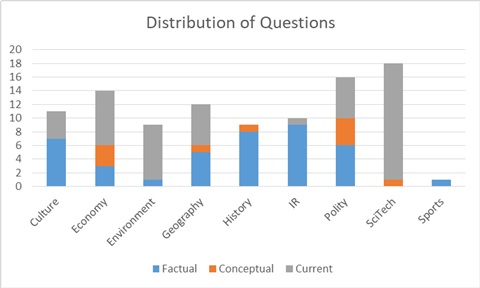
Very surprisingly Science and Technology had the highest share with 18 questions. Polity as always had a major chunk with 16 questions while Economy had same number of questions as last year i.e. 14. It was little shocking to see Environment getting under-represented with less than 10 questions.
Science and Technology: Out of 18, Applied Science and Modern Technology had 6 questions while UPSC’s favourite Information Communication Technology returned this year with 5 questions. Both these areas had questions from issues that are in discussion viz. various missions of Government, AI. Defence Technology and Biotechnology had 3 and 2 questions respectively. Space and Energy had one question each. As expected 17 out of 18 questions were originating from Current affairs with a solitary conceptual question. Science and Technology was moderately tough. For Sci-Tech, UPSC definitely expects aspirants to go beyond traditional sources and go in details of scientific aspects of issues in news.
Polity: Polity had 6 factual and 6 current based questions. However for the first time UPSC delved into conceptual angle of Polity with 4 understanding based questions from Governance and Constitution. Governance and schemes remained a major theme with 8 questions while ever important Constitution had 3 questions. Interestingly there were 3 questions from Security covering external and internal security issue. Another important topic Parliament had 2 questions. Overall Polity was moderately tough as there were many application oriented questions.
Economy: 3 factual, 3 conceptual and 8 current based questions made Economy a very challenging section this year. Out of 14, Finance had 5 questions and the newfound hotspot FinTech had 4 questions. Economy was definitely tougher due to application oriented questions and new areas explored. Another reason of toughness was less representation to conventional comfort zone topics like Banking (2), Macroeconomics (2) and Foreign trade (1).
Geography: Easier than last year but definitely challenging- Geography had main focus on Physical Geography and Geopolitics with 6 and 3 questions respectively. There was also representation thorough a single question each from Economic Geography (rare), Mapping (underrepresented) and World Geography. Out of 12, 5 questions were factual, 6 had current affairs orientation where one question tested conceptual clarity.
Culture: The toughest lot! Culture had a whopping 11 questions as against 2 last year. 7 factual questions were direct questions giving no chance to logic. Even 4 current based questions were off-beat. Architecture, a tougher subtopic had 4 questions whereas Arts and Religion had 3 and 2 respectively.
International Relations: The number of questions doubled to 10 this year, with 9 factual and only one current based question- which is a rarity. There were 5 questions each from Treaties and International Organizations. This section was definitely tough with focus on specific information and minute details.
Environment: Environment had only 9 questions out of which Biodiversity (5) had the biggest share. Ever important Climate change had 3 questions while there was one question representing Global Institutional Mechanism. Environment was moderate but one factual and 8 current based questions certainly demanded multidimensional thinking.
History: 9 questions from History were expectedly on tougher side with direct and specific questions from Modern History (5) and challenging questions from Ancient History (4). Except 1 conceptual question, all others were factual.
Sports: Sports had one factual question from Events (one less than last year). However it was an off-beat one from Sports Governance.
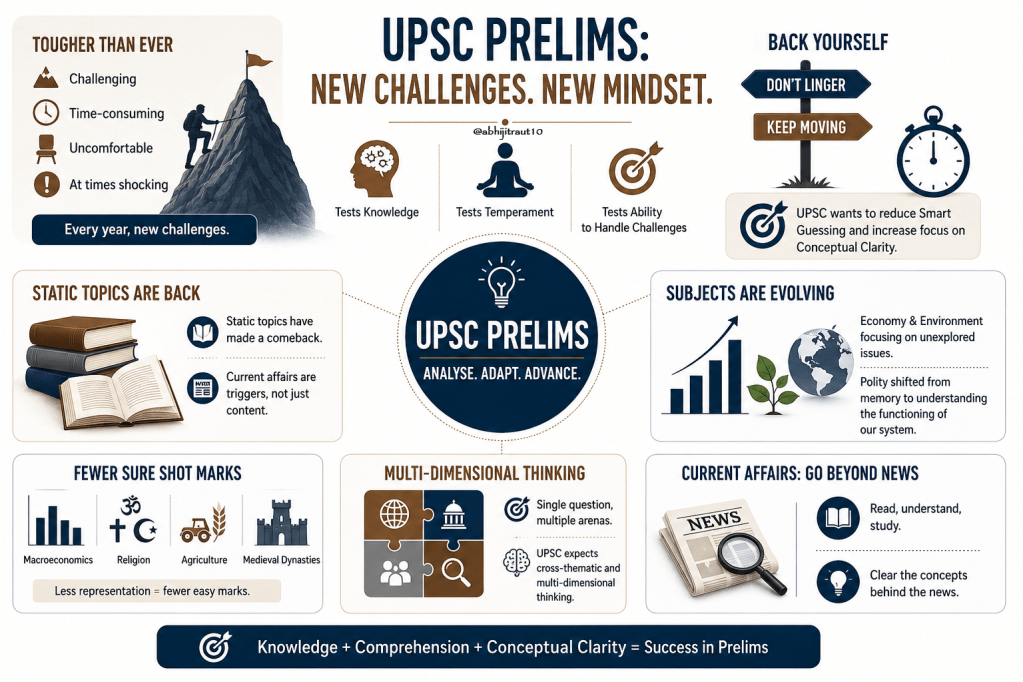
Challenging, time-consuming, uncomfortable, at times shocking- you may call it anything but it is a fact that UPSC Prelims will keep throwing new challenges every year. Such tough papers test not only knowledge but also aspirants’ temperament and ability to handle challenges. Many aspirants struggled to cover the paper entirely as it demanded lot of careful reading and thinking. One has to definitely work on reading and comprehension for GS too. In such papers it becomes important to back yourself and not to keep lingering on tough questions. It is clear that UPSC wants to reduce the role of Smart guessing and increase focus on conceptual clarity. Static topics have made a comeback in pre-CSAT era style. Also, Current affairs are not merely the content of questions but triggers also. So every news needs to be ‘studied’ properly with all background information.
Subjects like Economy and Environment are evolving with less focus on conventional topics and more on unexplored issues. Polity also saw a shift from memory to understanding the functioning of our system. Less representation to conventional areas like Macroeconomics, Religion, Agriculture, Medieval dynasties meant some sure shot marks were not available. UPSC is repeatedly expecting multi-dimensional and cross-thematic thinking with a single question testing multiple arenas. Questions from current affairs aimed to test one’s conceptual understanding. This highlights the fact that current affairs part is not merely about reading the newspapers/magazines/digests but it should include clearing all the concepts appearing in the news. Lastly, India’s stand on global issues and Governance Vision documents are extremely important as you can expect 7-10 questions from these areas any year.
The results will out in few weeks and one needs to plan accordingly. While preparing for the UPSC Mains examination, it’s essential to build a strong foundation by thoroughly understanding the basic concepts of each subject. Equally important is keeping yourself updated with trending and current issues, especially those frequently highlighted in the news. Don’t just skim through news articles. Analyze them deeply, understand the context, and explore the broader implications of each topic. Don’t underestimate India Year Book and Economic Survey.
Make answer writing a daily habit. The more you write, the better you get at structuring your thoughts, managing time, and presenting arguments effectively. Regular practice helps in refining your articulation and boosts your confidence. Most importantly, prepare with the mindset that anything can appear in the paper. UPSC often throws curveballs, testing not just knowledge but also adaptability and presence of mind. Equip yourself to face these challenges boldly and respond like a true champion: calm, prepared, and confident.
All the best!!
 Expressions and Impressions
Leave a comment