ALPEN is a time management technique that has become very popular and helps you with your time management – or in other words: to optimally structure your self-management.
A: Writing down tasks, appointments, and planned activities (Aufgaben)
L: Estimating length (Länge schätzen)
P: Planning buffer time (Pufferzeiten einplanen)
E: Making decisions (Entscheidungen treffen)
N: Following-up (Nachkontrolle)
The idea is to prepare a timed to-do list including only selected tasks that should take priority. The ALPEN method also encourages you to work during scheduled time blocks and take pre-scheduled breaks. With time set aside to refresh and decompress, so you can really go heads-down on tasks during those working hours.
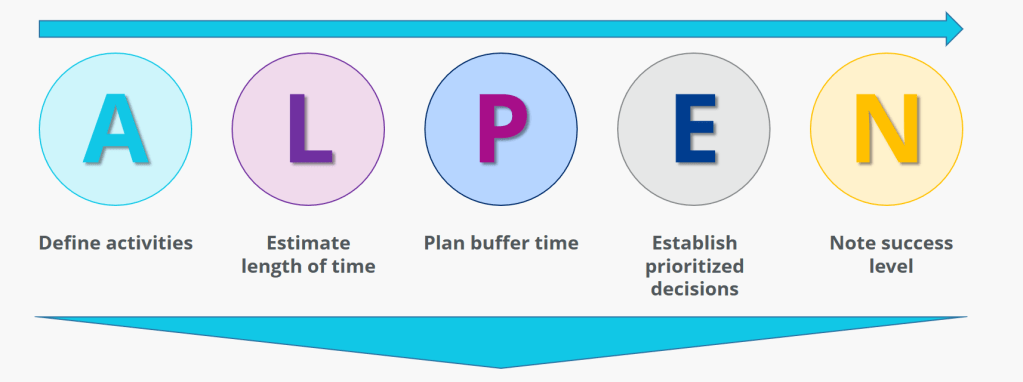
The components of ALPEN method can be briefly described as below:
- A – preparing a to-do list of all planned Activities, tasks and meetings
Write down all upcoming activities, from meetings to urgent e-mails and customer appointments. Start with putting all daily activities in a to-do list without bothering to keep it short.
- L – estimating Length of time
In the next step, you assign an estimated duration to all upcoming tasks. Most to-do lists are frustrating (and feel impossible) to complete because they’re drafted with unrealistic expectations. Simply putting tasks in a list doesn’t render them doable. Instead, allotting time to each task gives a fair idea of what you can realistically accomplish in a day. In this way, you use your time efficiently and productivity noticeably increases.
- P – Planning buffer time
You often expect unpredictable time losses. After all, there is always the chance of interruption. It adds in extra time to prevent task or appointment overflows from affecting your other plans. This effectively means less stressing and rushing when life doesn’t go exactly as you planned it.
E – Establishing prioritised decisions
Take a good look at your plan again. Start singling out tasks according to their urgency and importance. Which tasks are urgent and what could be postponed? What could be delegated? The Eisenhower Principle can help with prioritisation.
- N – Noting down level of success
After work, check if your estimates worked out. This method lives off experience values; make any adjustments that are required. And while you’re at it, you can already create the plan for the next working day. The goal of following-up is to move any pending tasks into your ‘To-do’ list for the next day and reflect on how well things went. These moments of retrospective reviews will allow you to move mountains in the future.
The ALPEN method is great for individuals looking to revamp their to-do list, but it can also be equally effective for using it to organize your team’s tasks.
Work management can be easy; with the ALPEN method: the time management method that demands you work with carefully drafted to-do lists, buffer time, and scheduled breaks to plan your day in a productive way.
References:
 Expressions and Impressions