Goal setting is a very critical component of productivity. If the goals are vague and generic, monitoring the progress becomes very hard. It becomes very tough to review and motivate in case of such goals. This severely dents the productivity. Hence techniques like SMART focus on Goal setting.
The SMART in SMART goals stands for Specific, Measurable, Achievable, Relevant, and Time-Bound. It is perfect for people who are in the early phases of a big project and need to strategize before jumping in. It helps to turn big, abstract ideas and goals into concrete, actionable plans.
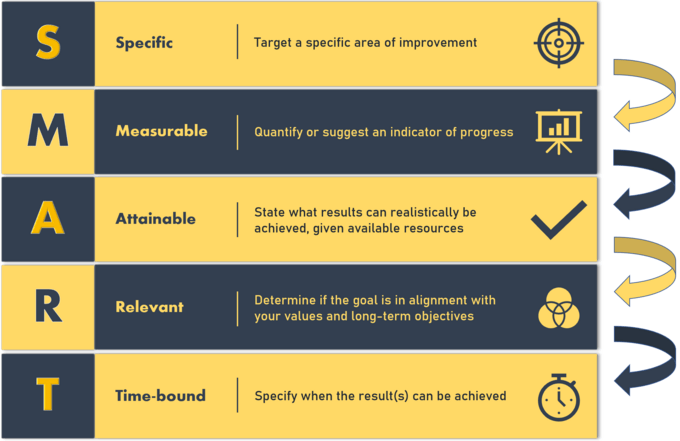
S: Specific
In order for a goal to be effective, it needs to be specific. You need to clearly define your goals and objectives to feel the motivation to accomplish the goals. A specific goal answers questions like:
- What needs to be accomplished?
- Who’s responsible for it?
- What steps need to be taken to achieve it?
Thinking through these questions helps get to the heart of what you’re aiming for.
M: Measurable
Specificity is a solid start, but making sure your goals are measurable makes it easier to track progress and know when you’ve reached the finish line. It helps you to visualize your progress in achieving goals in numerical values.
A: Achievable
This is the point in the process when you give yourself a serious reality check. Goals should be realistic — not pedestals from which you inevitably tumble. Ask yourself: is your objective something your team can reasonably accomplish? make sure you’re choosing realistic and attainable goals.
R: Relevant
Here’s where you need to think about the big picture. Why are you setting the goal that you’re setting? Does this goal match your other responsibilities? Do you have the skills to achieve this goal? This SMART goal-setting criterion ensures that you’re in control of your goals.
T: Time-bound
To properly measure success, you and your team need to be on the same page about when a goal has been reached. What’s your time horizon? When will the team start creating and implementing the tasks they’ve identified? When will they finish? This step ensures that you’re allocating sufficient time to long-term goals, short-term goals, and daily tasks.
Overall, SMART is perfectly suited for thinking through any big problem or project. However, when it comes to the day-to-day work of a complex undertaking SMART doesn’t have much to offer.
When you achieve your professional or personal goals without investing too much time, effort, and money, you’re more productive than others. SMART criteria of setting goals, reviewing progress, and adjusting tactics if you need, is the most easy-to-implement technique to boost productivity. Knowing how to set goals using the SMART framework can help you succeed in setting and attaining goals, no matter how large or small.
References:
 Expressions and Impressions
Leave a comment