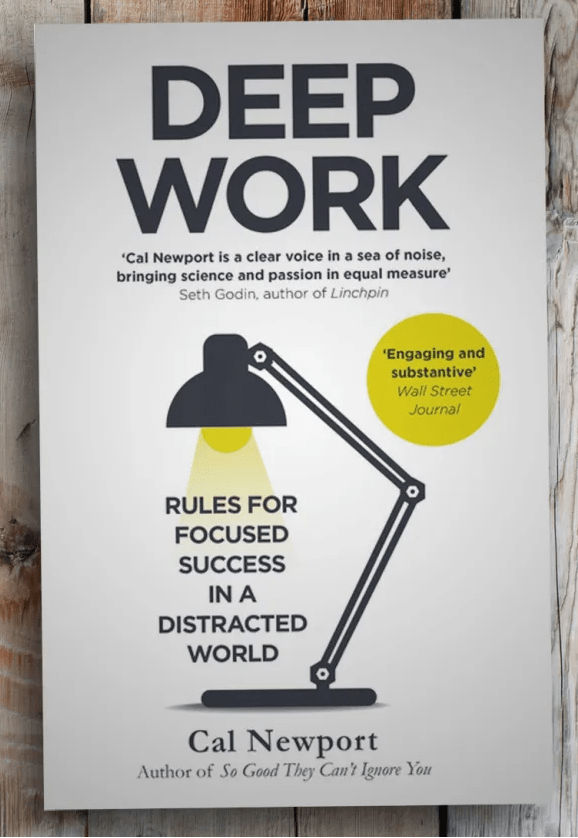
In Deep Work (Grand Central Publishing), author Cal Newport flips the narrative on impact in a connected age. Instead of arguing distraction is bad, he instead celebrates the power of its opposite. A mix of cultural criticism and actionable advice, Deep Work takes the reader on a journey through memorable stories and no-nonsense advice. Dividing this book into two parts, Newport first makes the case that in almost any profession, cultivating a deep work ethic will produce massive benefits. He then presents a rigorous training regimen, presented as a series of four “rules,” for transforming your mind and habits to support this skill. Deep Work is an indispensable guide to anyone seeking focused success in a distracted world.
Highlights:
1. Deep work is the ability to concentrate deeply on a difficult task for prolonged periods of time without getting distracted. It creates that intense, out-of-body kind of focus that makes you completely oblivious to what’s going on around you – the kind that produces your best work. Shallow work is non-cognitively demanding, logistical-style work, often performed while distracted. Deep work is like a superpower in our increasingly competitive twenty-first-century economy.
2. In order to produce the absolute best stuff you’re capable of, you need to commit to deep work. The ability to quickly master hard things and the ability to produce at an elite level, in terms of both quality and speed, are two core abilities for thriving in today’s economy.
3. To learn hard things quickly, you must focus intensely without distraction. Your work is craft, and if you hone your ability and apply it with respect and care, then like the skilled wheelwright you can generate meaning in the daily efforts of your professional life.
4. The key to developing a deep work habit is to move beyond good intentions and add routines and rituals to your working life designed to minimize the amount of your limited willpower necessary to transition into and maintain a state of unbroken concentration.
5. Depth Philosophies- There are a lot of different approaches – or “depth philosophies” – to make it fit your circumstances.
- The Monastic Philosophy is the most dedicated form of deep work and involves spending all of your working hours on a singular high-level focus. That means no social media, meetings, phone time, internet browsing or email. While there’s no set timeframe for this approach, the minimum unit for doing it tends to be at least one full day. It works best for professors and independent researchers who can immerse themselves in their work without negative consequences.
- The Bimodal Philosophy allows for a high amount of deep work while enabling you to maintain other activities in your life that you find valuable. It is about dividing your time between deep and shallow stretches, whether across days and weeks, or whole months at a time. It’s useful for people who can’t completely remove or ignore their shallow work obligations.
- The Rhythmic Philosophy is ideal for individuals with a fairly static schedule. If you can anticipate what most of your days will look like, it’s feasible to block off several hours every day for deep work, thereby getting into a daily “rhythm”, and leaving the rest of your hours for shallow work. While deep work won’t necessarily take up your entire day, you will protect space for it every day. It’s particularly handy for work that lacks pressure, like writing a book. Creating a rhythmic habit, where you do a bit of work every evening, can help you maintain progress.
- The Journalistic Philosophy is an option for people who are constantly on the move with little to no regularity to their days. It means switching to deep work mode whenever free time presents itself – mimicking the way journalists often work. If your work or lifestyle make it impossible to create a regular, structured routine for deep work, this is the best approach for you. But you need discipline to seize the opportunity and quickly lock focus whenever opportunity strikes.
6. Building a Deep Work Routine- Practicing intention with your time and considering when you’ll fit in periods of focus is an important part of succeeding with a deep work habit.
Make the following considerations when building a deep work ritual:
a) Location b) Duration c) Structure d) Requirements
7. Each deep work session should have a clear purpose and goal. Your brain is more engaged when it has a specific objective, and your time working deeply will yield more tangible results if you do. Imposing time limits can intensify your deep work, shifting you into a “scarcity mindset” that helps focus your attention. Time blocking is a great method for this. All communication outside your deep working space can wait until you’re done. You need to be ruthless to make sure all your attention is focused on your set task.
8. Without reviewing your performance, you can’t improve. Track how you spent your time and keep a score of how many deep work hours you’ve spent to create a sense of progress and productive pressure. Some people like to set milestones for each week (e.g. “read X number of pages” or “write X number of words”) to keep them working to a set rate.
9. Long stretches of intense concentration should be balanced with quality rest. So once you’ve completed a session of deep work, take a deep break. These are designed to give you a cognitive breather without introducing new distractions or stresses, so you can also use deep breaks to create healthy pauses throughout longer deep work sessions.
10. The Four Disciplines of Execution-
- Focus on the Wildly Important – Direct your effort to your most important goals during your deep work hours. Keep your biggest objectives at the forefront of your mind to make it easier to ignore distractions that don’t serve your long term goals. Try using sticky notes on your desk that list out your top priorities so you don’t forget them.
- Act on the Lead Measures – While you can attempt to maximize your lagging measure (i.e. number of blog posts published) it may be more valuable to optimize for your lead measure (i.e. number of hours spent writing in deep work). By increasing the number of hours you spend per week in a state of focused concentration, you’ll naturally be in a strong position to accomplish what you set out to.
- Keep a Compelling Scoreboard – Keep count of how many hours you spend in deep work mode and display your tracking somewhere visible to keep you motivated. Newport suggests keeping a pen and paper tally of how many hours you spend on deep work. Alternately, you can automate your scoreboard with time tracking tools.
- Create a Cadence of Accountability – In the absence of an accountability buddy, keep your word to yourself by committing to daily or weekly reviews of your progress. Check in on your scorecard and assess why you may be falling short of the goals you’ve set. If you’re exceeding them with ease, it may be time to push yourself further.
Courtesy:
 Expressions and Impressions
Brilliantly summarised the author’s thought.
LikeLiked by 1 person