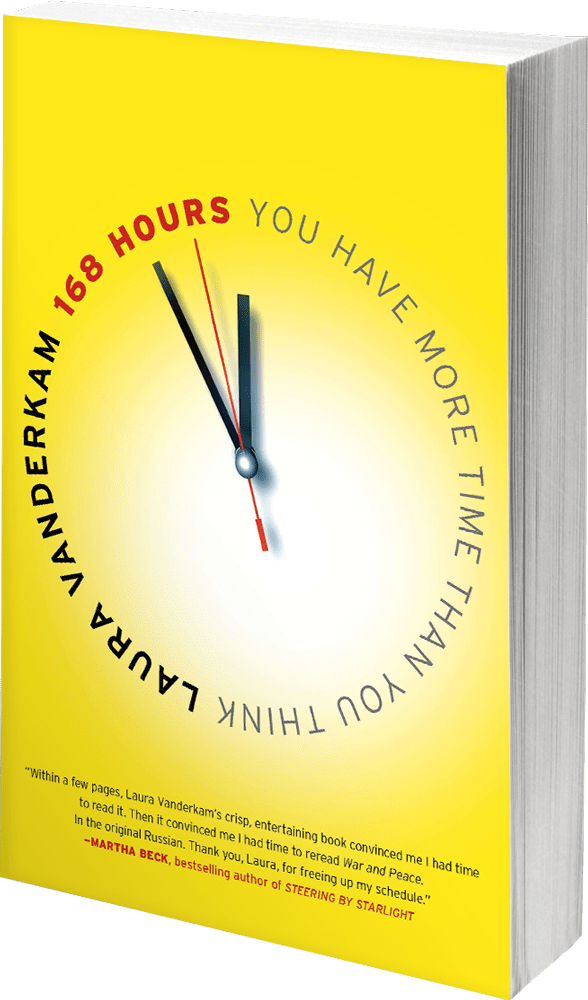
Author Laura Vanderkam shares some great insights on Time Management in her celebrated book 168 Hours: You Have More Time Than You Think (Penguin House Canada). This book talks about how we have more time than we think we do have and also discusses about the techniques for maximizing the time we have by focusing on our priorities. Some of the tips the author offers include recognizing your key competencies, finding a job you love, logging your hours, and outsourcing some tasks.
As Vanderkam points out, we all have 24 hours a day—or 168 hours in a week. However, we don’t get equal amounts done with our 168 hours. The difference is how ‘intentional’ one is with his/her time. 168 Hours is the story of how some people manage to be fully engaged in their professional and personal lives.
Pic: http://www.companyreads.prhspeakers.com
Highlights:
The time crunch myth: For 99.99% people, time crunch narrative doesn’t tell the complete story. Work rarely consumes 100% of anyone’s time. Even someone claiming to work 80-90 hours per weeks rarely works that hard.
Tracking your time: To better manage your time, create a system to track 168 hours of the week. That way, you will have a clear understanding of how you’re actually spending your time. Progressively, try to reduce unproductive time blocks.
Matter of choice: It is a choice, and not a matter of lacking time. You can’t put the entire blame of your busy-ness on someone else. If something is on your priority, you will find out time for it somehow. Set your priorities right.
Knowing yourself: Identifying your strengths and weaknesses has to be the starting point for your improvement. This will help you schedule things rationally by maximizing the advantage of your strengths and mitigating the weaknesses.
Controlling your schedule: Determine what you want to do with your life and seize control of the schedule to get there. The control may not be 100% but you need to keep increasing it. In the long run, the best way to create more time is to actually get better at your work.
Stop pretending work: We spend a lot of time being busy but doing things that aren’t actually productive. You have to seriously cut down this load, through delegation, deletion or outsourcing. The Author stresses to ‘Ignore-Minimize-Outsource’ such tasks.
Being efficient: Your focus must be achieving more quality output per unit time. Reduce your work by cutting out time spent on each task. Successful people are necessarily resource efficient- and Time is the most valuable resource.
The right job: The right job leverages your core competencies, which means you can maximize the things you do best and enjoy. You need to regularly reflect on what you want your life and career to look like.
Think long term: You need to have a clear vision about your progression. Try to create a picture of what your next step/level looks like and plan accordingly. Long term planning helps to better organize tasks, so as to amplify efficiency.
A full life: There is life beyond work! The target is not to work for 168 hours, but to plan in such a way that you can balance your quality work with family time, hobbies and social commitments in the168 hour cycle. Pick 2-4 hobbies or activities you want in your life. Focus on fitness as it acts as mood elevator and efficiency booster. Never compromise on family time.
 Expressions and Impressions
Leave a comment