Daniel Kahneman is a Psychologist who has been awarded the Nobel Prize in Economics for his work in decision making, specifically Prospect Theory. Kahneman in the book Thinking, Fast and Slow explains how we overestimate our abilities to make the right decision and correct judgments. He further reveals the limitations of intuition – our which is romanticized as something almost sacred but which nevertheless often lets us down.
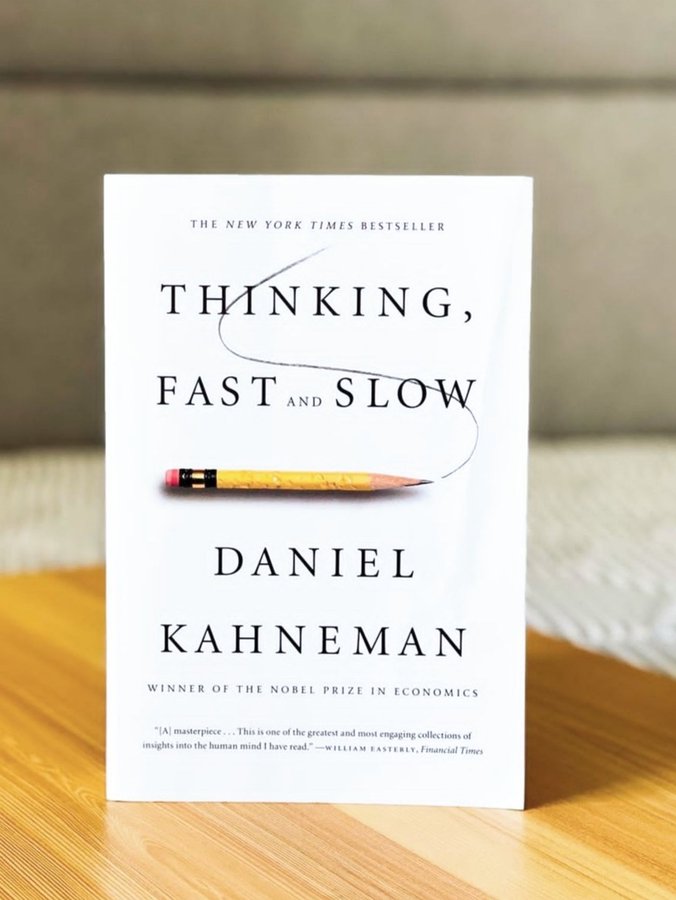
Pic: Twitter @1DeepNote
Highlights:
Two Systems: There are two characters that animate the mind. Author calls them System 1 and System 2, which are associated with our thought processes. System 1 is fast while System 2 is slow.
System 1 Is Innate: System 1 includes all capabilities that are innate. System 1 is a filter by which you interpret your experiences. It is the system you use for making intuitive decisions. It operates automatically and involuntarily; and runs continuously
System 2 can control parts of System 1: System 2 comprises a range of activities. But each of these activities requires attention and is disrupted when attention is drawn away. The operations of system 2 are often associated with the choice, and concentration. It’s only called upon when necessary to reason, compute, analyze and solve problems.
The Two Systems Support Each Other: That these two systems are actually integrated and mutually supportive. So, almost all tasks are a mix of both systems and are complementary. Kahneman elaborates on the “Law of Least Effort”, and how System 1 and System 2 work together to affect our perceptions and decisions.
Heuristics As Mental Shortcuts: Heuristics are mental shortcuts we create as we make decisions. We are always seeking to solve problems with the greatest efficiency. So, heuristics are highly beneficial for conserving energy throughout our everyday lives. However, heuristics leads to numerous mistakes in judgment – and to biases.
Regression to the Mean: Humans tend to identify lucky and unlucky streaks as a sign of future outcomes. People have a strong erroneous conviction that they can understand the past. Logically, this makes them believe they can predict the future.
Do not trust your Preferences to reflect your Interests: Decisions that do not produce the best possible experience are bad news for believers in the rationality of choice. We cannot fully trust our preferences to reflect our interests.
Hindsight significantly influences Decision-making: Kahneman notes that actions that seemed prudent in foresight can look irresponsibly negligent in hindsight. As humans, we cannot accurately reconstruct past beliefs or knowledge that has changed.
Prospect Theory: This theory is built on three key ideas. A) The absolute value of money is less vital than the subjective experience that comes with changes to your level of wealth. B) We experience reduced sensitivity to changes in wealth. C) We basically hate to lose money, and we weigh losses more than gains- Loss aversion.
Two Selves: Kahneman speaks about Two Selves – the experiencing self and the remembering self. They are different, and they are in a position of conflict – because we often confuse them.
Memories shape our Decisions: We want pain to be brief and pleasure to last. A single happiness value does not easily represent the experience of a moment or an episode. An individual’s mood at any moment depends on their temperament and overall happiness.
Best Decisions: Best decisions involve the optimum usage of System 2. Any decision which made based entirely on intuition or which is overanalyzed will most probably turn out to be a bad decision.
References:
@1DeepNote
 Expressions and Impressions
Nice article very thoughtful ! Really made me think. Especially memory shapes our decisions was wonderful.
LikeLiked by 1 person