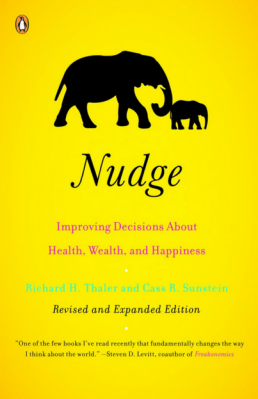
The book Nudge by Richard Thaler and Cass Sunstein discusses the concept of using behavioral sciences in public policy and managerial practices. The book talks about how people always go for the path of least resistance when it comes to making decisions. In order to help lazy decision makers pick the right choice, it is important to create nudges that help make them decisions that are beneficial. The book explores why people choose the path with the least friction in decision-making. It also details how states and organizations use nudges to influence people’s choices. This includes health, wealth, and happiness decisions. In the end, Nudge sheds light on the bias that creeps into the decision-making process. Nudge is a fascinating that simplifies concepts of behavioral economics and helps you understand the power of nudge using examples from the world of economics, finance, marketing, and even day to day life.
Pic: http://www.happybrainscience.com
Highlights:
- Our brain helps us make decisions in two ways or two systems. The automatic system or the intuitive system provides emotional responses or automatic actions. If you know how to cycle, then getting on cycle and pedalling away is an automatic decision, because you are habituated to cycling.
- The reflective system, on the other hand, is more deliberative and thinking oriented. If you do not know how to cycle, then learning to cycle is where the reflective system of the brain helps you. You put in all your focus and attention in learning the new skill, i.e. cycling. Once it becomes a habit, however, it then becomes a decision that is taken by the automatic system. (Details: https://abhijitraut10.wordpress.com/2023/05/15/thinking-fast-and-slow/)
- Humans naturally make mistakes and bad decisions. It’s possible to use nudges to help people make better decisions while still retaining their freedom of choice. A nudge refers to anything that shifts people’s behavior in a predictable way, without the use of drastic disincentives.
- Anchoring refers to making adjustments to making decisions based on perceived facts. The act of tying down decisions to specific facts (anchors) is anchoring. While anchors are great for problem-solving, they can also lead us to make poor choices.
- Availability refers to making decisions based on what you’re thinking about right now. By putting the availability bias to good use, we can make better decisions for everyone. Still, decisions based on the available information can also backfire.
- Repetitiveness bias is where people decide based on similar experiences. Like anchoring and availability, repetitiveness helps but also carries a risk. Only some experiences show how the future will be since things change.
- Status quo refers to making a decision and failing to take action to avert the consequences of it later. It is also called the doing nothing or default bias. This nudge affects people who are too lazy or busy to choose at a particular time. Failing to take action to prevent the consequences, you’ve succumbed to the default bias or doing nothing approach.
- The prospect of losing scares most people more than the excitement of gaining. When people are afraid to lose something, they’d rather not take a risk and win than take and lose. As with all nudges, the loss aversion bias can lead humans to make good and bad decisions.
- Optimism and overconfidence are powerful nudges in human life. They can influence both positive and negative choices. Unrealistic optimism causes people to overestimate or underestimate the rewards of their decisions. When people overestimate or underestimate the rewards of decisions, they make mistakes. As a result, they end up at a worse point than they were.
- The question is: which direction should you nudge people toward? The authors propose Libertarian Paternalism as the ideal approach. This combines libertarianism (giving the freedom of choice) and paternalism (influencing people to act in ways that make their lives better, as defined by them).
- Decisions are influenced by our environments and the options we have at the time. The way in which options are presented to us, including their form, style, and sequence, has a significant impact on our decision-making process. Choice architecture is about creating nudges that are most likely to benefit people and least likely to harm them. As a choice architect, you design the choice environments, and then design nudges that subtly, or not so subtly, nudge you towards the choice that is good for you.
- Humans often make the wrong financial choices. The world is full of people with regrets due to bad money choices. Most people make poor decisions on spending, debt management, retirement plans, and investing. Retirement nudge, Debt nudge, Insurance nudge, Investment nudge are some of the financial nudges humans receive to better their lives.
- Nudges are helpful for guiding people in a certain direction. Yet, choice architects are not infallible, so it’s important to let people have the freedom to make the final choice wherever possible. At times, additional incentives, mandates and bans may also be necessary for severe or complex issues.
References:
 Expressions and Impressions
Leave a comment