In his book, The Psychology of Money: Timeless Lessons on Wealth, Greed, and Happiness, author Morgan Housel uses interesting stories to illustrate our behavior towards money. The author argues that how smart we are and how we behave has little to do with how well we manage money. Housel explores how previous experiences, shifting goals, and being coldly reasonable can all harm long-term financial advantages. The alternative is to set clear, acceptable financial objectives that rely only a little on past financial achievement. If you can implement these strategies, you will be financially successful in the long term. As a result, you will profit from the miracles of compound interest.
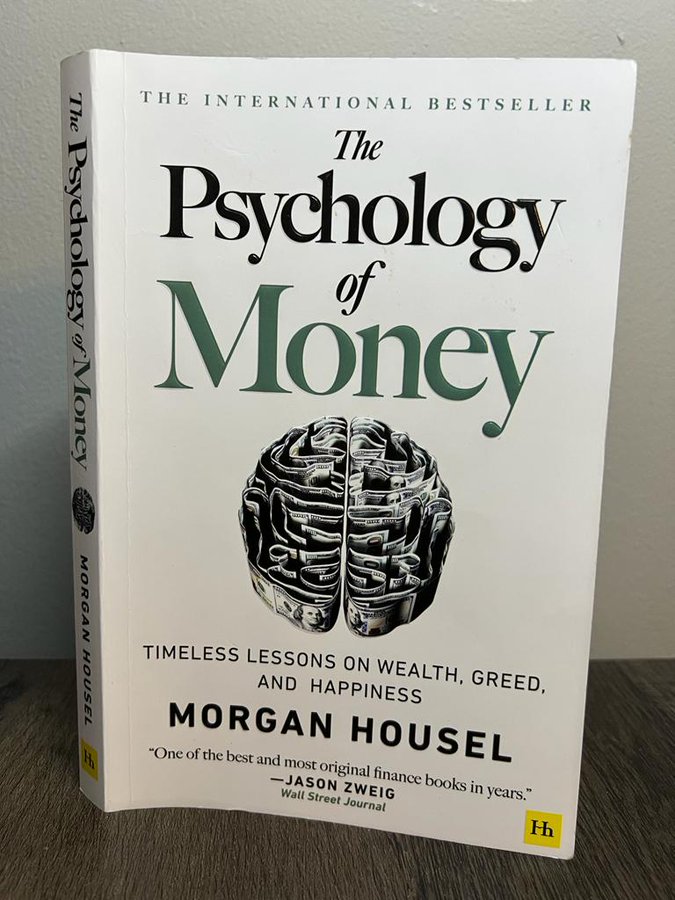
Pic: Twitter @AccentInvesting
Highlights:
# Financial success is not a hard science. It’s a soft skill, where how you behave is more important than what you know. Doing well with money has a little to do with how smart you are and a lot to do with how you behave.
# Wealth is hidden. It’s income not spent. Wealth is an option not yet taken to buy something later. Its value lies in offering you options, flexibility, and growth to one day purchase more stuff than you could right now.
# Spending money to show people how much money you have is the fastest way to have less money. When most people say they want to be a millionaire, what they might actually mean is “I’d like to spend a million dollars.” And that is literally the opposite of being a millionaire.
# One of the most powerful ways to increase your savings isn’t to raise your income. It’s to raise your humility. Savings can be created by spending less. You can spend less if you desire less. And you will desire less if you care less about what others think of you.
# The highest form of wealth is the ability to wake up every morning and say, “I can do whatever I want today. Money’s greatest intrinsic value – and this can’t be overstated – is its ability to give you control over your time.
# There is no reason to risk what you have and need for what you don’t have and don’t need. It’s one of those things that’s as obvious as it is overlooked.
# Like everything else worthwhile, successful investing demands a price. But its currency is not dollars and cents. It’s volatility, fear, doubt, uncertainty, and regret – all of which are easy to overlook until you’re dealing with them in real time.
# To grasp why people bury themselves in debt you don’t need to study interest rates; you need to study the history of greed, insecurity, and optimism.
# Only saving for a specific goal makes sense in a predictable world. But ours isn’t. Saving is a hedge against life’s inevitable ability to surprise the hell out of you at the worst possible moment. There is never a moment when you’re so right that you can bet every chip in front of you. The world isn’t that kind to anyone – not consistently, anyways. You have to give yourself room for error. You have to plan on your plan not going according to plan.
# One of the deeply held investing beliefs is that there is little correlation between investment effort and investment results.
# A genius who loses control of their emotions can be a financial disaster. The opposite is also true. Ordinary folks with no financial education can be wealthy if they have a handful of behavioral skills that have nothing to do with formal measures of intelligence.
# Compounding only works if you can give an asset years and years to grow. It’s like planting oak trees: A year of growth will never show much progress, 10 years can make a meaningful difference, and 50 years can create something absolutely extraordinary.
# There are a million ways to get wealthy, and plenty of books on how to do so. But there’s only one way to stay wealthy: some combination of frugality and paranoia.
References:
Twitter @AccentInvesting
 Expressions and Impressions
Leave a comment