In a world overloaded with information and complexity, success often comes down to how well you think. The most successful individuals—entrepreneurs, investors, thinkers—don’t necessarily work harder; they think better. They apply mental models: timeless cognitive tools that simplify complex decision-making and cut through the noise.
This article based on an infographic by http://www.mindstream.news explores 16 powerful mental models that can elevate your thinking and decision-making to top-tier levels.
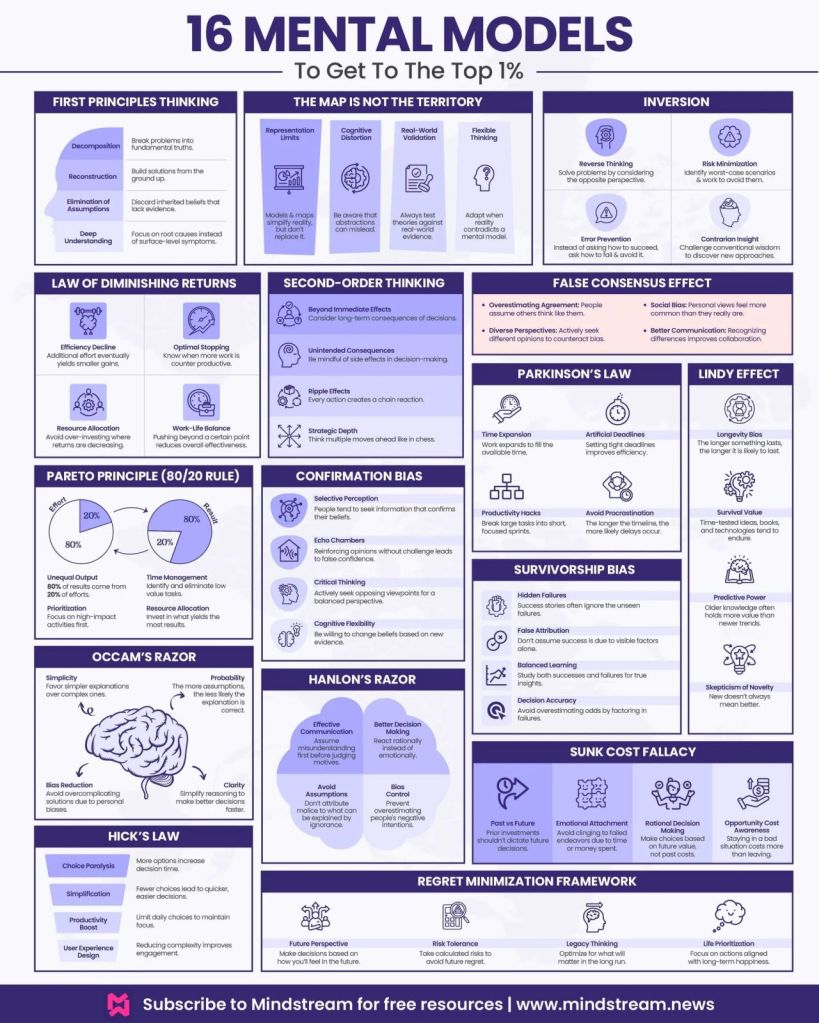
Image from http://www.mindstream.news
1. First Principles Thinking: Think From the Ground Up
Instead of relying on assumptions or analogies, break problems down into their most fundamental truths and reason from there. This model helps you challenge conventional wisdom and discover innovative solutions.
- Break problems into their core parts.
- Eliminate assumptions.
- Build solutions from scratch with deep understanding.
2. The Map Is Not the Territory: Reality vs. Representation
A model, plan, or assumption is just a simplification of reality. Never confuse it for the real thing.
- Beware of cognitive distortion.
- Always test ideas in the real world.
- Stay flexible and adapt when reality doesn’t match expectations.
3. Inversion: Think in Reverse
Sometimes the best way to solve a problem is by thinking backward. Instead of asking, “How do I succeed?” ask, “How could I fail?” and avoid those pitfalls.
- Focus on risk minimization and error prevention.
- Challenge mainstream ideas.
- Solve problems by considering the opposite perspective.
4. Law of Diminishing Returns: More Isn’t Always Better
After a certain point, putting in more effort or resources yields proportionally smaller benefits.
- Recognize when marginal gains decline.
- Avoid overworking with little output.
- Reallocate resources strategically.
5. Second-Order Thinking: Look Beyond the Immediate
Great thinkers consider not just the direct consequences of their actions but also the ripple effects.
- Think in layers: what happens next, and then after that?
- Avoid unintended consequences.
- Make strategic, long-term decisions.
6. False Consensus Effect: You Are Not the Norm
We tend to assume others think like us, but that’s rarely true.
- Recognize social and cognitive bias.
- Seek diverse perspectives.
- Avoid projecting your views onto others.
7. Parkinson’s Law: Work Expands to Fill the Time
If you give yourself a week to complete a task, it’ll take a week—even if the task only requires a day.
- Set tighter deadlines.
- Use artificial constraints to improve focus.
- Avoid unnecessary delays.
8. Lindy Effect: Age = Anti-Fragility
The longer an idea or practice has survived, the more likely it is to continue.
- Time-tested ideas are often more reliable.
- Old knowledge has withstood scrutiny.
- Use the past to predict future robustness.
9. Pareto Principle (80/20 Rule): Focus on the Vital Few
Roughly 80% of outcomes come from 20% of inputs. The key is identifying the high-leverage actions.
- Prioritize the small number of tasks that deliver big results.
- Eliminate or outsource the rest.
- Work smarter, not harder.
10. Confirmation Bias: Don’t Just Look for Proof
We naturally seek information that supports our beliefs and ignore what contradicts them.
- Actively challenge your views.
- Step outside echo chambers.
- Stay open to changing your mind.
11. Survivorship Bias: Don’t Just Study Winners
We often analyze only successful people or companies and forget the countless others that failed.
- Look for hidden failures.
- Don’t let success stories blind you to broader patterns.
- Learn from both winners and losers.
12. Occam’s Razor: Simpler Is Usually Better
When presented with multiple explanations, choose the simplest one that fits the facts.
- Avoid overcomplicating.
- Don’t add unnecessary variables.
- Trust in simplicity.
13. Hanlon’s Razor: Don’t Jump to Malice
Not all mistakes or conflicts are intentional. Sometimes, they’re just due to ignorance or error.
- Practice empathy.
- Reduce unnecessary conflict.
- Give people the benefit of the doubt—until proven otherwise.
14. Hick’s Law: More Choices = Slower Decisions
The more options you have, the longer it takes to decide. This leads to analysis paralysis.
- Simplify your choices.
- Streamline your environment.
- Reduce friction in decision-making.
15. Sunk Cost Fallacy: Let Go of the Past
Just because you’ve invested time, money, or energy into something doesn’t mean you should continue with it.
- Ignore past costs when making decisions.
- Focus on future value.
- Know when to walk away.
16. Regret Minimization Framework: Think from the Future
Make decisions today that your future self will thank you for. Jeff Bezos famously used this when deciding to start Amazon.
- Project yourself into the future.
- Choose the path with fewer long-term regrets.
- Take calculated risks to avoid “what ifs.”
Understanding and applying these mental models can significantly improve your thinking, problem-solving, and decision-making. They offer a mental toolkit to help you approach life more strategically—whether you’re running a business, managing your time, or just trying to live more intentionally.
Start small. Pick one model. Apply it. Reflect. Repeat.
That’s how you rise into the top 1%.
Courtsey: Big thanks to http://www.mindstream.news Follow this site for more such wonderful content.
 Expressions and Impressions
Thanks for sharing such actionable wisdom!”
LikeLiked by 1 person
very useful information sir..
LikeLiked by 1 person
Whenever i Feel Lost in Mental Productivity, Sir i just visit your blog and Get Refreshed with New Ideas and Strategies Unlocked. Thanks for the Blogs Sir. From AB
LikeLiked by 1 person
सुस्पष्ट आणि सहज..
LikeLiked by 1 person
There is a general inclination for our minds to focus on problems rather than solutions. You have provided a clear summary of the issues, their background research titles & methods for reaching wise decisions.
LikeLiked by 1 person
point no 11 is very imp…. 👍🏻
LikeLiked by 1 person
Excellent 👌👍 Post Sir.
You explained life sciences, Success principles and strategies for balanced life.
I could see lot of things in your elections period in Nanded Loksabha and Vidhan Sabha.
Keep educating us.
Thank you 👍😊
LikeLiked by 1 person
most important
LikeLiked by 1 person
Sir it is so informative
some of the points i learnt during my special training
thanks for sharing with me
LikeLiked by 1 person