Public speaking can feel intimidating, whether you’re addressing a large audience, pitching a new idea to your team, or leading a workshop. But speaking effectively isn’t reserved for a chosen few—it’s a skill anyone can develop with practice, strategy, and the right mindset. Below are 12 actionable secrets designed to help you speak with greater confidence and clarity, ensuring your message resonates and leaves a lasting impact on your listeners.
(Elaborated from an infographic by @jobsgtbm)

1. Hook, Not Bio
Instead of starting with “I’m happy to be here” or giving a long list of your credentials, begin your talk with something that sparks genuine curiosity. This could be a surprising statistic, a bold statement, a thought-provoking question, or a vivid, relevant anecdote. Grabbing attention from the first few seconds is critical—it wakes up your audience and makes them eager to hear what follows. You can always share your background once they’re engaged, but your priority at the start is to captivate, not to credential.
2. Start Still
As you step onto the stage or stand in front of your audience, resist the urge to rush into speaking. Pause briefly—take a deep breath, plant your feet about shoulder-width apart, and let your body settle. This short moment of intentional stillness conveys poise and self-assurance before you even open your mouth. It also helps quiet your nerves, gives your audience a moment to focus, and sets a calm, controlled tone that can carry through your entire presentation.
3. Group in Threes
Our brains naturally process and recall information better when it’s grouped into threes. Structuring your main content around three key themes, ideas, or takeaways helps your audience remember what you say. Use phrases like, “Here are three insights you can apply today…” to set clear expectations. This framework keeps your talk organized, easier to follow, and gives it a satisfying sense of completeness—making your message stick long after you finish speaking.
4. Use Short Stories
Stories breathe life into abstract concepts, but length matters. Aim for concise stories—ideally under 90 seconds—that focus on just the essentials: set the scene to give context, introduce the conflict to build interest, and finish with the payoff that ties back to your main point. Editing out unnecessary details keeps your stories sharp and powerful, making them more memorable and impactful for your audience.
5. Edit Actively
When refining your script or notes, replace passive phrases and vague words with clear, direct language. For instance, instead of saying “A mistake was made,” say, “We made a mistake.” This small shift makes your delivery feel more authentic and confident. Strong, active verbs energize your speech, while passive language can come across as hesitant or less engaging. Active editing sharpens your message and keeps listeners’ attention focused where it belongs.
6. Speak to One Person
Instead of letting your gaze drift randomly across the room, try focusing on one person at a time while you share each idea. Maintain eye contact for a complete thought or sentence, then move naturally to someone else as you introduce a new point. This technique creates moments of real connection, making your talk feel more personal and conversational rather than rehearsed or detached.
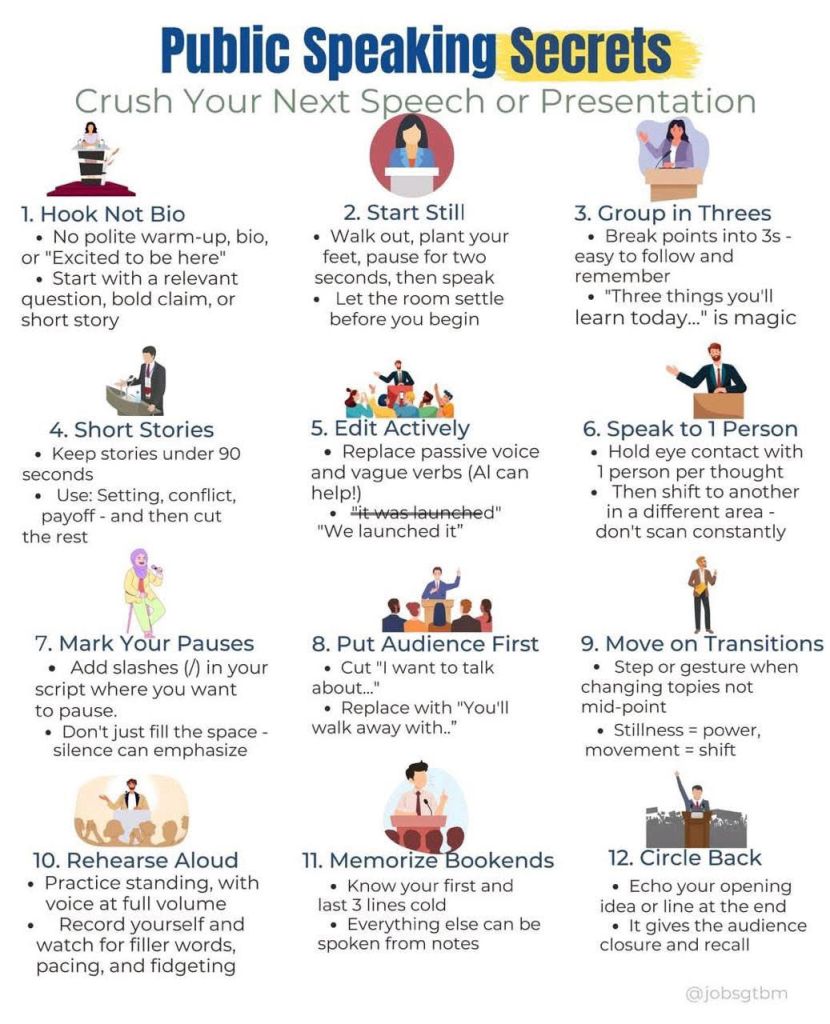
7. Mark Your Pauses
Purposeful pauses aren’t just empty spaces—they emphasize key points and give your audience time to reflect. While writing or practicing your talk, mark intentional pauses with a slash (/) or another symbol. Avoid filling every silence with words or filler sounds like “um” or “uh.” Instead, let the silence speak for you: it can add weight to your message and make your delivery feel more thoughtful and deliberate.
8. Put Audience First
Shape your content around what your audience will gain, rather than what you want to share. Swap phrases like “I want to tell you about…” with “You’ll discover how to…” or “By the end of this talk, you’ll know…”. Framing your presentation this way makes it feel more relevant and valuable to listeners. When people clearly see what’s in it for them, they’re naturally more invested and attentive.
9. Move on Transitions
Use intentional movement—like stepping to one side, changing posture, or using a hand gesture—when you shift between major topics. These cues signal change and keep the energy dynamic without becoming distracting. Avoid pacing aimlessly, which can look nervous and pull attention away from your words. Instead, combine stillness during important points with controlled movement during transitions to create a balanced, engaging delivery.
10. Rehearse Aloud
Reading your notes silently is not enough preparation. Stand up and practice your talk out loud, projecting your voice as you would in front of an audience. Record yourself if possible and watch for filler words, awkward pauses, or repetitive gestures. Speaking aloud helps you internalize your material, fine-tune your pacing, and build confidence, so you sound natural rather than memorized.
11. Memorize Bookends
You don’t need to memorize every word of your speech, but knowing your opening and closing lines by heart is invaluable. A strong, polished opening captures attention immediately, while a clear, intentional ending ensures your audience remembers your key message. Between these bookends, you can rely on notes or bullet points to guide your delivery, keeping it spontaneous yet structured.
12. Circle Back
Finish your presentation by revisiting your opening idea, story, or question. This technique ties everything together and provides a satisfying sense of closure for your audience. It reinforces your main message and helps listeners see the full arc of your talk, making it more cohesive and memorable.
Mastering public speaking isn’t about flawless performance—it’s about thoughtful preparation, authenticity, and connecting with your audience. These 12 practical secrets can elevate your next speech or presentation from average to impactful. With regular practice and reflection, you’ll gain confidence, speak more naturally, and leave a lasting impression on those who hear you. Try applying just a few of these tips today—and watch how your presence and message become stronger, clearer, and more memorable.
 Expressions and Impressions
Knowledgeable
LikeLiked by 1 person
Nicely elaborated facts of mastering a speech.
LikeLiked by 1 person
very effective step discussed sir
very helpful 🫡
LikeLiked by 1 person
Most informative blog sir
LikeLiked by 1 person
Excellent 👌👍 summary.
Stories are really important aspect.
Thank you.
LikeLiked by 1 person
Excellent sir
LikeLiked by 1 person
Enlightening and very helpful, sir
LikeLiked by 1 person
Very helpful in developing the speaker’s skills
LikeLiked by 1 person
nice article. thanks.
LikeLiked by 1 person
Wonderful article, sir. I especially liked how you emphasized mindset and strategy Thank you for inspiring us!
LikeLiked by 1 person
Thank you so much for sharing but do you have classes because am really badly off even when I start speaking my eyes start tearing because of fear thank you
LikeLiked by 1 person
Start practicing. Listen good public talks- Ted talks, Podcasts, interviews, cricket commentary.No class can teach that.
LikeLike
Loved this tip about memorizing your opening and closing to create impact—that’s so true! I’ve found that having structured bullet points really frees you up to connect with the audience. I wrote about my journey moving from nervous talks to confident speeches here: https://ajayshealthblog.blogspot.com/2025/08/learn-public-speaking.html.
Hope it resonates!
LikeLiked by 1 person
Thanks.
Went through your blog. Very nicely expressed. Keep writing and sharing!!
LikeLike