Naal, directed by Sudhakar Reddy Yakkanti, is a film that beigns with a whisper. It tiptoes into your heart with the soft innocence of a child, and by the end, leaves you with a lump in your throat and a river of thoughts flowing quietly inside. Set in a simple Maharashtrian village, Naal (meaning “umbilical cord”) is not just a story of a boy. It is a journey back to the idea of belonging, motherhood, and the emotional knots that life quietly ties and sometimes loosens. Producer Nagraj Manjule appears in his first full length role along with Devika Daftardar and Deepti Shrikant and other actors shining through their roles.
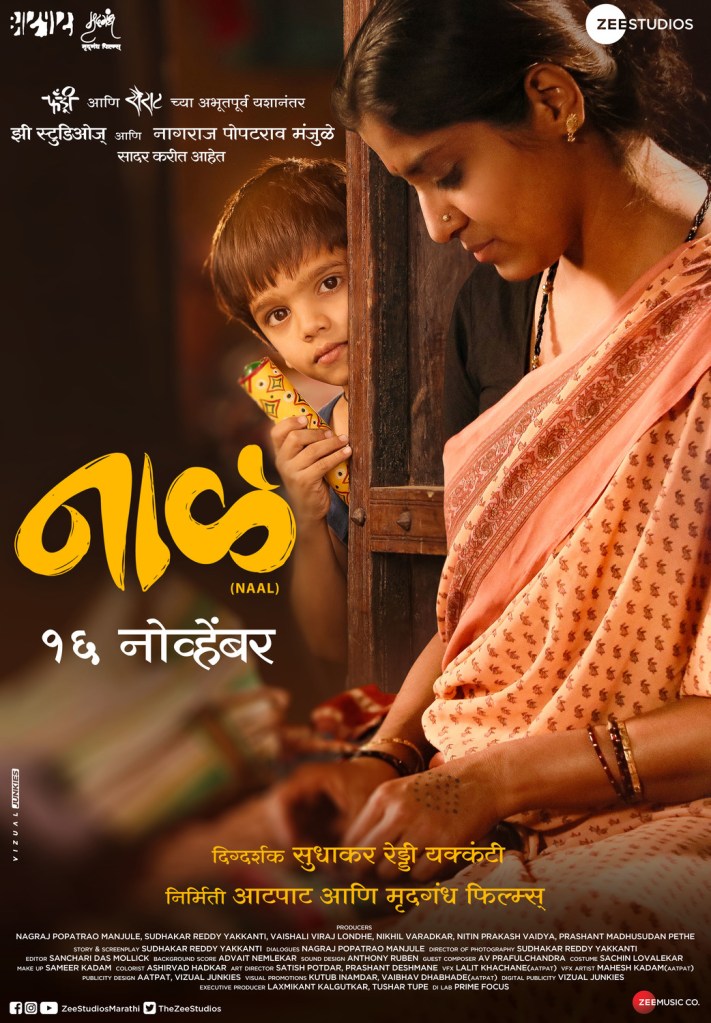
However the film belongs to Chaitya (played remarkably by Shrinivas Pokale), a mischievous and curious boy growing up in the lap of rural nature and unconditional maternal love. His life is unremarkable in its routine—school, play, village gossip. But a sudden revelation changes everything: the woman he calls “Aai” may not be his biological mother.
From that point on, the film becomes a quiet storm. Chaitya’s emotional landscape shifts—he still smiles, plays, asks innocent questions, but behind those eyes, something begins to churn. He embarks on a deeply personal, deeply silent quest to find his real mother. Not out of rebellion, but out of wonder. What does a mother mean to a child who has only known one kind of love?
Naal uses childhood to explore a deeper, primal bond—the one between mother and child. But it never gets dramatic or preachy. The film never tells you what to feel. It simply follows the child’s gaze. It allows silence to speak more than dialogues. Sudhakar Reddy Yakkanti’s cinematography is a gentle poem—capturing the golden light of farmlands, the playfulness of rural streams, and the texture of village life. Each frame feels like it belongs in a memory. The background score is minimal, evocative, and perfectly tuned to the emotions that are too complex for a child to name and too deep for adults to explain.
The climax of Naal doesn’t arrive with loud music or tears. It comes with acceptance. A realization that life is sometimes a blend of many truths, and love—genuine love—doesn’t need labels. Last 20 minutes or so do not have any prominent dialogue- whatever chitchat we hear is just a part of the background while young Chaitya tries to speak through his eyes and actions- only to find his real mother stealing away her gaze and his adoptive mother quietly yet uncomfortably seeing all this interaction. It’s all about the eyes!
At its core, Naal is about roots—not just biological but emotional. It raises important, quiet questions: Is motherhood defined by birth or by care? Is love ever incomplete if the truth remains hidden? Why do children forgive so easily, but never forget? Naal is about the journey of a child discovering the difference between the one who gave birth and the one who gave love. And how sometimes, both exist—just on opposite sides of a quiet river. Naal gently holds your hand and takes you back to your own roots. It is cinema at its purest—honest, fragile, and unforgettable.
 Expressions and Impressions
Leave a comment