Su From So arrives like a pleasant surprise: unassuming, playful, and quietly thoughtful. At first glance, it feels like a simple rural comedy rooted in everyday quirks and harmless chaos. But as the film unfolds, it becomes clear that its laughter is intentional, almost strategic. Beneath the humour lies a sincere attempt to address a serious social issue, introduced so subtly that it never feels heavy or preachy. The film’s greatest strength is this balance: it makes you smile first, think later, and leave with a gentle sense of emotional clarity. Directed by the first-timer JP Thuminad, the Kannada film cast includes a host of actors from the Mangalore region, many of which feature in Kantaara.
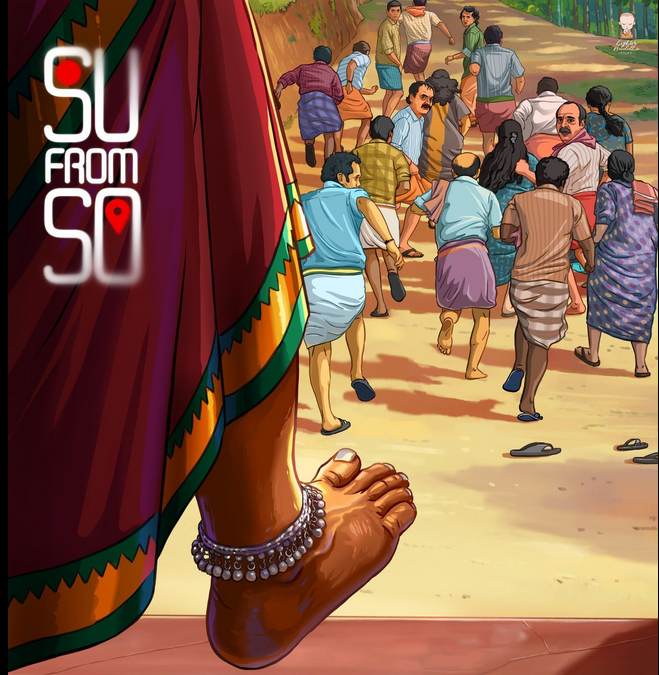
Set in a village Marlur that feels alive with curiosity and collective innocence, the story revolves around a young man Ashoka (Thuminad himself) who, in a bid to save himself from embarassment, pretends to be possessed by a ghost. What begins as a harmless act quickly spirals out of control, trapping him in the very lie he created. His performance forces him to confront not only the villagers’ superstitions but also his own conscience as the situation grows heavier than he anticipated. The villagers led by Ravi Anna (Shaneel Gautham) and Guruji (hilariously portrayed by Raj B. Shetty) try to get rid of the ghost. As the narrative unfolds, the young man’s pretence takes on unexpected consequences with introduction of the daughter of the alleged ghost, who has long carried emotional scars. Through his act, he inadvertently helps her confront the past and find closure.
The characters in this tale are written with a fresh and realistic viewpoint. Ravi is thoughtful, observant, and emotionally grounded; whose tragicomic past becomes the closure point of the movie. Ashoka, in contrast, is expressive, reactive, and driven by instinct. He mirrors the village’s initial panic and excitement, often amplifying rumours, yet his journey is one of growth. Bhanu’s character appears in the second half which adds emotional angle to the storyline, reinforcing the film’s humane core. Karunakar Guruji and all the other villagers represent the people we see in our day to day life.
Using humour as its primary lens, the story examines how ordinary communities respond to uncertainty, often allowing imagination and collective anxiety to overpower reason. Rather than judging these reactions, the film treats them with empathy, showing that fear is a shared human response rather than a flaw. The film uses chaos as an entry point into a serious issue—women’s safety. What begins as comic confusion gradually reveals how discomfort, silence, and misdirected fear often mask deeper societal problems. By steering the narrative toward dialogue, empathy, and reason, the film offers a logical and humane resolution
In the end, Su From So succeeds because it trusts simplicity. It introduces a serious social concern through laughter, allows characters to grow naturally, and resolves the conflict with logic rather than spectacle. The closure feels earned, reassuring, and quietly uplifting. By the time the final moments arrive, the film leaves you with more than amusement: it offers a gentle reminder that fear loses its power when met with empathy, dialogue, and collective wisdom.
 Expressions and Impressions
Leave a comment