Ten Simple Techniques for improving Efficiency
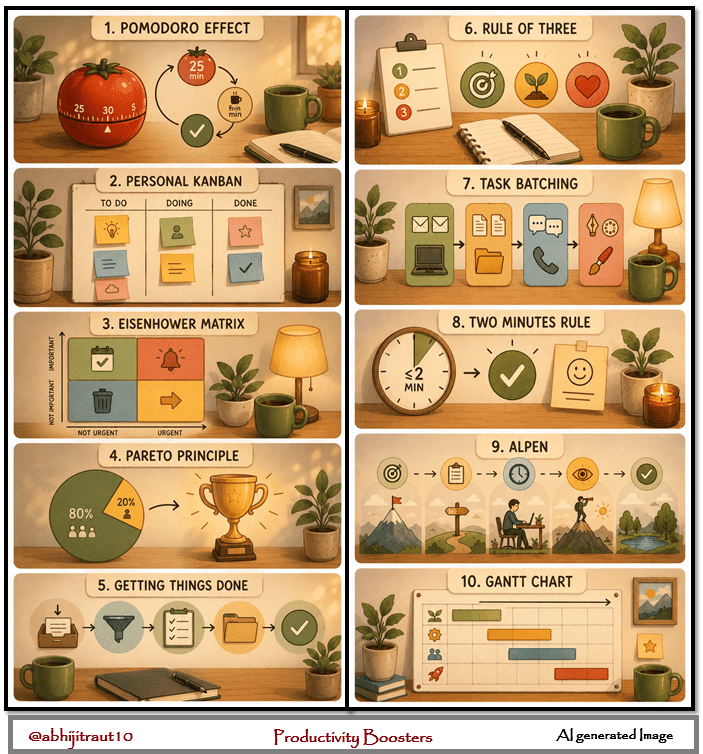
Productivity isn’t a single trick but a toolkit, and the right technique depends on the kind of friction you’re fighting: whether it’s a cluttered mind, a wandering focus, or a project with too many moving parts. The following ten methods, drawn from time-tested frameworks across personal and project management, each tackle a different facet of getting things done: some structure how you visualize and limit work, others govern how you spend focused minutes or decide what deserves your attention at all. Together they form a varied playbook, useful less as a single system to adopt wholesale than as options to draw from depending on the problem at hand.
Pomodoro Technique
The Pomodoro Technique is a time management method designed to deliver maximum focus and mental freshness by breaking work into structured sprints. The core rhythm is simple: work for 25 minutes (one “pomodoro”), take a 5-minute break, and after four such sessions, reward yourself with a longer 15–30 minute break. Each sprint is treated as an indivisible unit: no checking phone or emails, no switching tasks; and every completed pomodoro is marked to track progress and note moments of distraction or urge to procrastinate.
The technique’s real strength lies in three supporting rules that keep it effective: large tasks must be broken into smaller steps that fit within a few pomodoros; tiny tasks should be batched together; and once a pomodoro starts, it cannot be interrupted. This structure combats distraction, builds self-awareness about how long tasks actually take, and makes deep work feel less daunting because committing to just 25 minutes is far easier than staring down hours of unbroken effort. Four pomodoros can constitute a genuinely productive morning, with focused output and minimal fatigue.
Full article: https://abhijitraut10.wordpress.com/2022/01/23/pomodoro-technique/
Personal Kanban
Personal Kanban adapts the team-based Kanban project management framework for individual use, built around two non-negotiable rules: visualize your work and limit your Work In Progress (WIP). The idea is to maintain a simple board with typically three columns: To-Do, In Progress, and Complete; so that at any moment you have a clear, at-a-glance picture of your entire workload, with visible cues for priority and effort. This visual clarity removes the mental overhead of juggling tasks in your head and lets you make smarter decisions about what to tackle next.
The real power of Personal Kanban lies in the WIP limit i.e. deliberately capping how many tasks sit in the “In Progress” column at once (ideally 1–3). This guards against the productivity trap of multitasking and forces you to finish what you’ve started before picking up something new. The system stays effective when you keep tasks concrete and time-bound (a few hours to a few days each), maintain separate boards for different life domains like work and home, and remain flexible enough to add columns like “In Review” as your workflow demands. The simplicity is the point: it’s a productivity tool that works with your natural tendencies rather than against them.
Full article: https://abhijitraut10.wordpress.com/2022/01/26/personal-kanban/
Eisenhower Matrix
The Eisenhower Matrix is a decision-making framework that sorts every task into one of four quadrants based on two axes: urgency and importance. Tasks that are both urgent and important get done immediately; those that are important but not urgent get scheduled for later; urgent but unimportant tasks get delegated to someone else; and tasks that are neither urgent nor important simply get deleted. This four-quadrant filter forces you to consciously evaluate each task rather than reactively chasing whatever feels most pressing in the moment.
The deeper insight of the matrix is that most people spend their days trapped in the urgent: firefighting and responding, while neglecting the truly important work that shapes long-term outcomes. The technique nudges you to protect time for Quadrant 2 (important, not urgent) activities like planning, learning, and relationship-building, which rarely demand attention but deliver the most lasting value. Paired with practical habits viz. keeping a single consolidated task list, limiting tasks per quadrant, and not letting others dictate your priorities, the matrix turns overwhelming to-do lists into a clear, actionable hierarchy.
Full article: https://abhijitraut10.wordpress.com/2022/02/07/eisenhower-matrix/
Pareto Principle
The Pareto Principle, also known as the 80:20 rule, holds that roughly 20 percent of your activities account for 80 percent of your results. Rather than a strict mathematical law, it’s a conceptual lens for identifying which small subset of actions or tasks is actually driving most of your success, and the idea applies across both professional and personal domains. The core insight is that effort and outcome are rarely proportional. A small fraction of what you do generates the bulk of the value, and the most consequential tasks tend to be the hardest and most demanding, even though they yield the largest payoff.
Applying the principle follows a simple four-step process: track your activities to see how each one contributes to outcomes, identify the key “major” tasks driving most of the results, focus your energy and strategic rethinking on those majors, and then devise a separate strategy such as delegating or batching for the remaining “minor” tasks. The payoff is a clearer sense of where to allocate limited time and energy for maximum impact, helping you restructure your day around your most productive hours and reduce wasted effort, though the article cautions that the 80:20 split isn’t universal and the line between majors and minors can shift depending on context.
Full article: https://abhijitraut10.wordpress.com/2022/02/26/pareto-principle/
Getting Things Done
Getting Things Done (GTD) is a comprehensive system for organizing to-do lists, priorities, and schedules, built on the premise that the more information you keep bouncing around in your head, the harder it becomes to decide what deserves attention; leading to stress and overwhelm instead of action. The fix is to externalize everything into a trusted system through five core steps: capture every thought or task into an inbox regardless of size, clarify each item into a concrete next action, organize it into the right place (calendar, delegated list, reference file), review the system regularly to keep it current, and finally engage by working on the right next actions.
GTD works well for people who want a highly analytical, structured approach and already have some clarity on their goals, offering reliability and flexibility once the system is running, and it scales to team settings for delegation and collaborative brainstorming. Its tradeoff is complexity: it demands consistency and frequent readjustment, and isn’t well suited to unprioritized or unstructured work.
Full article: https://abhijitraut10.wordpress.com/2022/03/07/getting-things-done-gtd/
Rule of Three
The Rule of Three shifts focus from activities to outcomes, ensuring effort goes toward results that actually matter rather than just churning through a to-do list. It works by naming three things you want to accomplish today, three for the week, and three for the year, giving you a layered set of targets spanning the immediate, the near-term, and the long-term.
Execution follows from there: break each outcome into the specific tasks needed to achieve it, deprioritize everything outside that list until those tasks are done, and review your day afterward to check whether you hit your three outcomes, refocusing the next day if you didn’t. The method’s appeal is its simplicity and big-picture clarity, though it works best when you have real autonomy over your daily tasks. But if your day is dictated by others, the Rule of Three loses much of its power.
Full article: https://abhijitraut10.wordpress.com/2022/03/21/rule-of-three/
Task batching
Task batching groups similar activities requiring a common skill, similar nature, or similar level of attention into dedicated clusters of time, rather than scattering them throughout the day. The aim is to break the cycle of distraction: by committing to one type of task within a focused block, you tap into momentum and avoid the mental cost of constantly switching between different modes of thinking, since each task switch forces your brain to “catch up” to a new context.
The method runs on four steps: build a to-do list that breaks big projects into smaller tasks, assign a time frame to each batch, group similar tasks together (by area or by attention level), and block 30–60 minute intervals to work through each batch without multitasking. Its effectiveness sharpens further when you first question whether a task needs doing at all (outsourcing or deleting low-value work), match low-energy batches to your daily slumps while reserving peak-focus hours for demanding work, and set firm time limits so batches don’t sprawl and consume more of the day than intended.
Full article: https://abhijitraut10.wordpress.com/2022/06/13/task-batching/
Two Minute Rule
The Two Minute Rule is a simple anti-procrastination technique with a clear premise: if an action will take less than two minutes, do it immediately rather than tracking or deferring it. The logic is an efficiency cutoff: past a certain point, the effort of recording and remembering a task exceeds the effort of just finishing it, and small neglected tasks quietly accumulate into a real drag on productivity. Completing a task immediately, especially while already in a related flow, is also faster than returning to it later, since restarting carries its own setup and re-engagement cost.
A useful extension of the rule is habit formation: shrink any new habit down to a two-minute version so it’s effortless to start e.g. one page of reading instead of a chapter, or two minutes of breathing instead of a full yoga session. The point is to lower the barrier to beginning, since the opening two minutes should never feel like a challenge; once started, momentum makes it far easier to continue, turning the tiny action into a gateway toward a larger, more productive habit.
Full article: https://abhijitraut10.wordpress.com/2022/05/29/two-minute-rule/
ALPEN
ALPEN is a German-origin time management technique built around five sequential steps, each named for a German word: writing down all tasks and activities (Aufgaben), estimating how long each will take (Länge schätzen), planning buffer time for interruptions (Pufferzeiten einplanen), making prioritized decisions about what matters (Entscheidungen treffen), and following up at day’s end to note what succeeded (Nachkontrolle). The method’s structure forces realism into daily planning: a to-do list alone is frustrating and rarely completed because it ignores time constraints, but assigning a duration to each task and deliberately reserving slack for the unexpected makes the plan something you can actually execute without constant rushing or stress.
After listing and timing tasks, ALPEN borrows prioritization logic (similar to the Eisenhower Principle) to separate what’s urgent, what can wait, and what can be delegated, then closes the loop with an evening review that checks estimates against reality and rolls any unfinished work into the next day’s list. This retrospective habit is what makes the method self-correcting over time, and it scales just as well to organizing a team’s workload as it does to a single person’s day.
Full article: https://abhijitraut10.wordpress.com/2022/04/04/alpen/
Gantt chart
A Gantt chart is a bar chart that lays a project’s tasks out against a timeline, capturing who is responsible for what, how long each task will take, and where activities overlap or depend on one another. It’s built in five steps: define an overall start and end date for the project, add individual tasks each with their own start and end dates, map out dependencies between tasks that can’t begin until others finish, mark milestones as fixed checkpoints that signal major progress, and keep the chart flexible enough to update as plans inevitably shift.
The real value of building a Gantt chart isn’t just the visual. It forces you to think through every task in a project upfront, assign ownership, estimate duration, and anticipate bottlenecks, which surfaces the minimum realistic delivery timeline and the correct task sequencing before work even begins. It also doubles as a communication tool, letting a team or stakeholders see schedule changes and completed milestones at a glance. The tradeoff is overhead: a Gantt chart takes more effort to set up than simpler planning methods and demands frequent, granular updates to stay accurate, with the risk of becoming cluttered as fine detail piles in. Yet despite this, it remains a widely used project management staple.
Full article: https://abhijitraut10.wordpress.com/2022/05/16/gantt-chart/
What ties these ten techniques together is a shared belief that productivity improves not by working harder, but by working with more intention, visualizing tasks instead of carrying them in your head, protecting focus instead of fragmenting it, and prioritizing outcomes instead of just checking boxes. No single method suits every situation: a Gantt chart is overkill for a personal to-do list, just as the Two Minute Rule won’t manage a multi-team project. The real skill lies in recognizing which constraint is actually limiting you in the moment: clarity, focus, prioritization or structure; and reaching for the technique built to solve that specific problem.
 Expressions and Impressions
Thanks for insightful consolidated view of all tools at one place..!!
LikeLiked by 1 person
👍🏻
LikeLiked by 1 person
nice techniques
LikeLiked by 1 person
sir this is an excellent technique for improving productivity
LikeLiked by 1 person
Very nice article….this will work efficiently
LikeLiked by 1 person
Very very nicely written.Its an excellent article and is useful for not only the Ptofesdionals but for the Comman Man also. Thanks for sharing.
LikeLiked by 1 person
👍
LikeLiked by 1 person
Worth reading.in your busy schedule appreciate time taken.busiest persons are most productive persons.
Rule of 2 min I do follow each time and yes it speaks getting work done on time.
Very happy to read and spread.
thank you Mr Raut sir.
Best wishes for further narration.
LikeLiked by 1 person