Every fortress appears invincible; until the day someone dares to challenge the myth surrounding it. For more than three decades, the Gabba stood as Australian cricket’s strongest bastion, a venue where visiting teams arrived burdened more by history than by the opposition itself. Generations of great cricketers had walked into Brisbane only to leave with another reminder of Australian supremacy. The ground seemed to possess an aura of Australian inevitability, where fast bowlers found relentless bounce, batsmen accumulated runs with ruthless efficiency, and the hosts rarely allowed hope to breathe.
But history has an unusual habit of rewarding those who refuse to acknowledge its limits. In January 2021, an injury-ravaged Indian team walked into Brisbane carrying little certainty, but an abundance of courage. Yet history often chooses the least likely heroes.
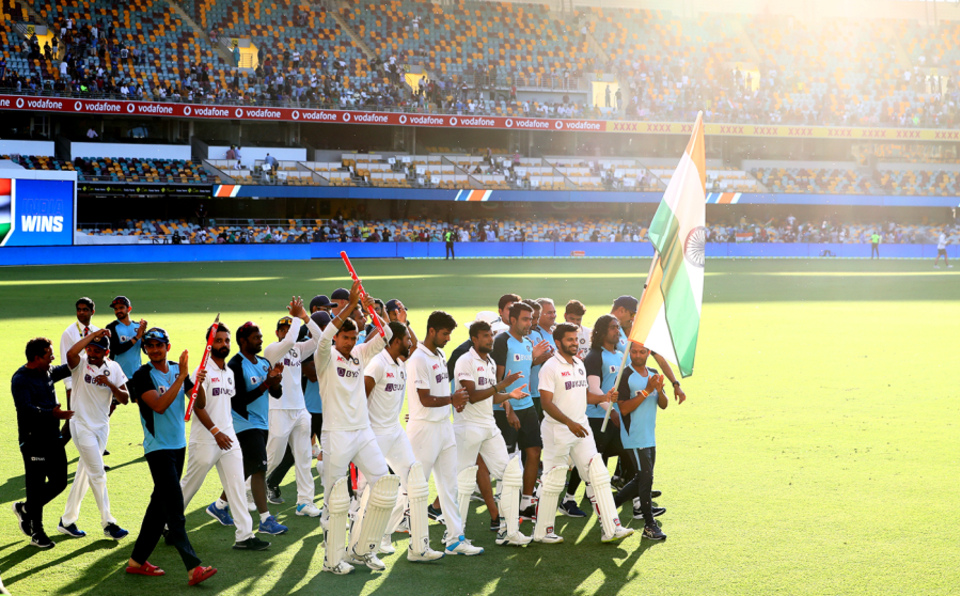
Courtesy: Chris Hyde/Cricket Australia/Getty Images Cricinfo
The Indian team that arrived in Brisbane hardly resembled the side that had landed in Australia a month earlier. It carried the scars of an unforgettable journey, both physical and emotional. The captain, Virat Kohli, had already returned home after the opening Test. Mohammed Shami, Umesh Yadav, Ravindra Jadeja, Hanuma Vihari, Ravichandran Ashwin, Jasprit Bumrah: one after another, injuries robbed India of experience and certainty. By the time the fourth Test began, India fielded a bowling attack so inexperienced that few outside the dressing room believed it could withstand Australia’s batting.
The series had begun in the darkest imaginable fashion. Adelaide delivered humiliation unlike anything Indian cricket had experienced in decades. Thirty-six all out. Every dismissal seemed to chip away not merely at the batting order but at the confidence of an entire nation. Critics predicted a one-sided series. Without Kohli, without momentum and burdened by the psychological weight of that collapse, India appeared destined to fade quietly into the Australian summer.
But the beauty of sport lies in its refusal to honour inevitability. Melbourne became the first chapter of resurrection. Ajinkya Rahane, the stand-in captain for the series, produced an innings of remarkable composure. His century did far more than level the series. It restored belief. India reminded itself that disasters do not define champions; responses do.
Sydney transformed that belief into defiance. Battling injury and exhaustion, Cheteshwar Pujara absorbed punishment with unwavering patience while Hanuma Vihari and Ravichandran Ashwin stitched together one of the most courageous rearguard actions Test cricket has witnessed. The draw felt almost like a victory because it demonstrated that this team had discovered something deeper than form: it had found resilience.
Thus the series reached Brisbane. Australia trusted history. India trusted character.
Winning the toss, Australia amassed 369, powered by another assured century from Marnus Labuschagne. The innings reflected everything expected of the hosts: disciplined batting, patient accumulation and relentless pressure. India, already relying on an inexperienced pace attack, knew they could ill afford a batting collapse.
And that possibility arrived swiftly. At 186 for 6, India’s recognised batsmen had returned to the pavilion. Australia’s quicks sensed the familiar scent of dominance. Another collapse appeared inevitable. The Gabba seemed ready to reaffirm its reputation. Instead, two unlikely architects began rebuilding the ruins.
Washington Sundar, making only his Test debut, displayed elegance far beyond his experience. At the other end, Shardul Thakur answered every challenge with fearless strokeplay and stubborn resistance. Their partnership of 123 runs was not merely valuable, it altered the emotional rhythm of the Test. Every boundary chipped away at Australian certainty. From apparent collapse emerged 336, a total that restored parity and, more importantly, belief.
The second Australian innings carried the urgency of a team sensing that time was slipping away. Yet India’s inexperienced attack refused to be intimidated. Mohammed Siraj, now unexpectedly leading the pace attack, bowled with remarkable heart. Shardul struck crucial blows at vital moments. Together they repeatedly interrupted Australia’s momentum. Wickets arrived just when partnerships threatened to flourish. Australia were dismissed for 294, leaving India a daunting but conceivable target of 329.
One final examination remained. The chase began nervously. Rohit Sharma departed early, reminding everyone how unforgiving fourth-innings pursuits can be. But Shubman Gill played an innings that announced the arrival of a remarkable talent. His fluent 91 balanced elegance with fearless intent, refusing to let Australia’s bowlers dictate terms. Ajinkya Rahane added a brisk cameo that shifted the tempo, ensuring the chase never became overwhelming.
One man was steady like a rock on the other end- Cheteshwar Pujara. Few innings have demanded greater physical courage. Blow after blow struck his body as Australian fast bowlers searched for intimidation. He wore the bruises without complaint, each painful impact becoming another small act of resistance. Pujara understood that sometimes the greatest contribution is not acceleration but endurance. His innings became the immovable foundation upon which others could dream.
At the opposite end, another fable was getting written. Rishabh Pant represented an entirely different philosophy. Where Pujara absorbed pressure, Pant dismantled it. His strokeplay remained adventurous, yet beneath the audacity lay remarkable judgement. He chose the right moments to attack, the right moments to defend and, above all, refused to let Australia’s bowlers settle into predictable rhythms. Innovation merged seamlessly with maturity.
When wickets fell in quick succession, uncertainty returned. The fortress sensed an opportunity to reclaim its authority. Washington Sundar walked in once again, and together with Pant steadied the innings through a priceless partnership of 53 runs. Their calmness ensured panic never took hold. Even after late wickets threatened another twist, Pant remained composed. Great finishers possess the rare ability to make chaos appear manageable. Pant carried that quality throughout the final session.
As the winning runs pierced the field, the scoreboard simply recorded 329 for 7. History recorded something infinitely greater. The fortress had fallen.
Australia had not lost at the Gabba since 1988. India led by Rahane had arrived battered by injuries, missing its captain and relying on bowlers with scarcely any Test experience. Conventional logic suggested they should have been overwhelmed. Instead, they produced one of the finest overseas victories in cricket history. Perhaps that is why the Gabba Test continues to resonate years later. It was never merely about ending Australia’s unbeaten record in Brisbane. It was about proving that resilience is cumulative. It begins with recovering from failure, grows through calm leadership, strengthens with collective belief and ultimately flourishes when ordinary individuals embrace extraordinary responsibility.
The journey from 36 all out to conquering the Gabba fortress remains one of cricket’s greatest reminders that champions are not those who never fall. They are those who transform every setback into the first chapter of an unforgettable triumph.
 Expressions and Impressions
Leave a comment