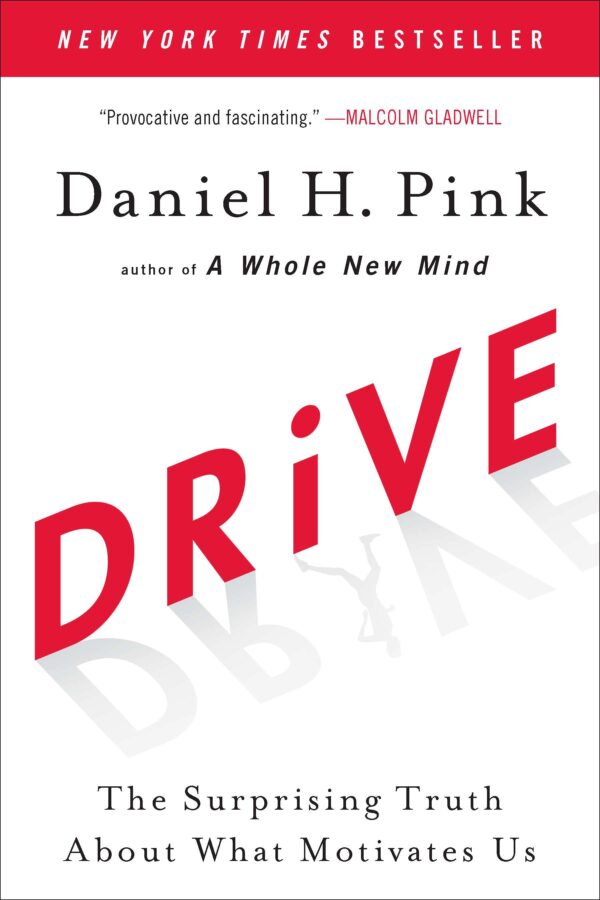
Daniel H. Pink’s Drive: The Surprising Truth About What Motivates Us challenges the traditional belief that people are primarily motivated by rewards and punishments. Drawing on psychological and behavioural research, Pink argues that while money and incentives matter, they do not fully explain what drives people to perform, create and excel.
Pink calls the traditional reward-and-punishment system Motivation 2.0 and proposes a newer model, Motivation 3.0, built around three innate human needs: Autonomy, Mastery and Purpose. The book explores how these three forces can create deeper engagement and more sustainable motivation in workplaces, schools, families and our personal lives.
Highlights
Rewards can reduce intrinsic motivation
People often enjoy activities for their own sake. Introducing external rewards can sometimes turn an enjoyable activity into a transaction and weaken the original interest.
Motivation 2.0 is becoming outdated
Rewards and punishments work well for routine, clearly defined tasks, but modern work increasingly demands creativity, judgement, problem-solving and self-direction.
Carrots and sticks have hidden costs
Rewards can diminish performance, crush creativity, encourage unethical behaviour, create dependence and promote short-term thinking. The harder and more creative the task, the greater these risks can become.
Rewards work; but only in the right circumstances
Pink does not reject incentives. They are useful for routine work when people are fairly compensated, understand why the task matters and retain some freedom over how they perform it.
Type I beats Type X in the long run
Type X behaviour depends mainly on external rewards, while Type I behaviour is powered by intrinsic motivation. Pink argues that Type I behaviour is more sustainable and can be cultivated through the right environment.
Autonomy: give people ownership
People are naturally motivated when they have greater control over their work and lives. Pink describes autonomy through four dimensions: Task, Time, Technique and Team.
Mastery is the desire to keep improving
People want to become better at things that matter to them. Mastery requires effort, deliberate practice, feedback and patience; and is a journey that never truly ends.
Purpose answers “Why does this matter?”
People want their efforts to contribute to something larger than themselves. Organizations therefore need to communicate not just what they do, but why they do it.
Flow makes work deeply rewarding
When challenge and ability are well matched, people can enter a state of flow, where concentration deepens and the activity becomes rewarding in itself. Flow may be temporary, but mastery is the longer journey.
Progress is a powerful motivator
Motivation is strengthened when people can see themselves improving. Instead of focusing only on final performance, meaningful work should create opportunities for continuous progress and learning.
The lessons apply beyond the workplace
Pink extends Motivation 3.0 to education, parenting and fitness. The common principle is to replace excessive control and external incentives with greater autonomy, meaningful goals, opportunities for mastery and a sense of purpose.
Autonomy + Mastery + Purpose = sustainable motivation
The entire book ultimately revolves around three questions: Do I have control over my life? Am I becoming better? Does what I do matter? Together, autonomy, mastery and purpose create the conditions for engagement and self-directed excellence.
Drive asks us to move beyond the question “How do we make people do their best?” and instead ask “How do we create conditions in which people want to do their best?” For Pink, the answer lies in giving people ownership over their direction, opportunities to improve and a reason to believe their work matters.


Leave a Reply