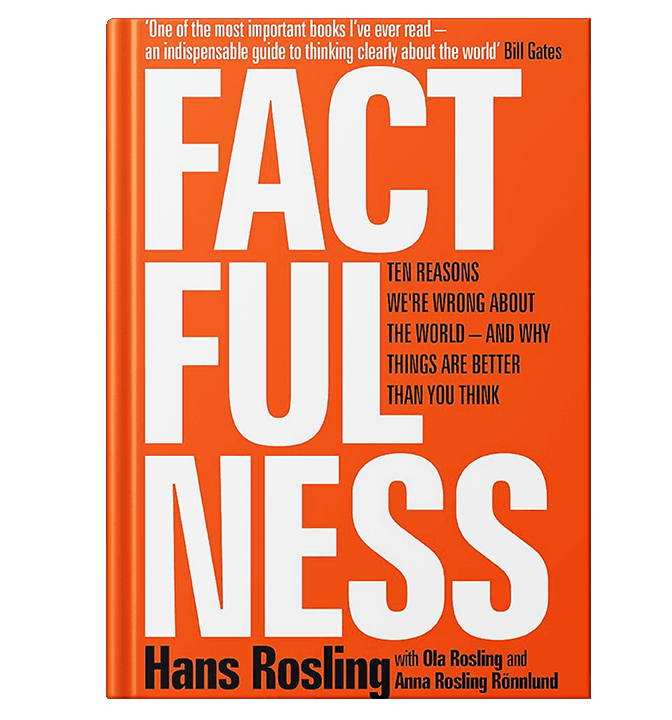
Factfulness by Hans Rosling, Ola Rosling, and Anna Rosling Rönnlund focuses on the idea that we systematically overestimate how bad the world is on many of the most important metrics, such as poverty, violence and income. Rosling believes this overdramatic worldview is mainly the result of ten instincts that distort our perspective of the world and prevent us from seeing how it actually is. Factfulness is an attempted antidote to these instincts, demonstrating how our approach to facts and data can counter these innate biases.
The authors believe that the world is improving; step-by-step, year-by-year. Not on every single measure every single year, but as a rule. Though the world faces huge challenges, we have made tremendous progress. This is the fact-based worldview. This book focuses on the same positive perspective. This book inculcates the stress-reducing habit of only carrying opinions for which you have strongly supported facts.
Highlights:
The Ten Instincts
The Gap Instinct: The gap instinct describes our tendency to divide things into two distinct and often conflicting groups with an imagined gap in between them. Most common example of this instinct is to divide the world based on income. However, the world has grown too complex to be understood in simple categories like developed versus developing, with most countries living neither as high-income or low-income but simply a middle-income majority. If you study neutrally, you would probably find that the groups we imagine are actually overlapping. There is probably no gap at all. The world is better understood by imagining data distributions on a bell-curve rather than as a series of opposing polarities.
The Negativity Instinct: The negativity instinct describes our tendency to notice the bad more than the good. Hence, we also believe the world is getting worse. We tend to respond with feelings instead of facts, which means we feel uncomfortable saying the world is getting better. We need to distinguish between a level (e.g., bad) and a direction of change (e.g., better). Good events or gradual improvements are seldom reported. We must not let negative stories warp the world’s reality; and we should consider how things have improved.
The Straight Line Instinct: The straight line instinct describes our tendency to assume that a line will just continue straight i.e. to believe that things will continue as they have before. We expect that improvement in the world must mean constant improvement with no dips. However, multiple factors impact the trend. The best way for us to control this error-filled instinct is to remember that curves can come in all shapes and sizes, and to accept that straight lines are far less common than we think.
The Fear Instinct: The fear instinct describes our tendency to pay more attention to frightening things. Specifically, we tend to generate worst-case scenarios when provided with data. The image of a dangerous world is being hammered through broadcast. However the incidences of violence have come down. We need to understand the true picture and minimize decisions taken in the state of fear.
The Size Instinct: The size instinct describes our tendency to get things out of proportion, or misjudge the size of things. We often miss the trick by focusing on a single number, and overestimating the importance of single events or people. The size instinct, together with the negativity instinct, make us systematically underestimate the progress that has been made in the world. This can be countered by comparing and dividing. Compare the data you have with a standard baseline. Focus on rates or percentages rather than absolute values. The 80-20 rule can become handy here.
The Generalization Instinct: The generalization instinct is our tendency to generalize groups, ignoring the significant differences between them. We mistakenly group together things, or people, or countries that are actually very different. We assume everything or everyone in one category is similar. Experience is the key to beat this instinct. We also need to question the categories, and find better ones.
The Destiny Instinct: The destiny instinct is our tendency to assume innate characteristics determine the destinies of people, countries, religions and cultures. We consider that things are as they are, and that they have always been this way and will never change. This leads to false generalizations. To control the Destiny Instinct, stay open to new data and remember that slow change is still change. We should be prepared to refresh knowledge, and compare it with the pre-existing one.
The Single Perspective Instinct: The single perspective instinct is our tendency to prefer single causes and single solutions, instead of adopting or considering multiple perspectives. Being always in favour of or always against any particular idea makes you blind to information that doesn’t fit your perspective. We will get a more accurate understanding of problems if we consider multiple perspectives and weigh up which has the most validity. To overcome the single perspective instinct, you should always be testing ideas to see where they fall short. A single perspective can limit your imagination, and hence it is better to look at problems from many angles to get a more accurate understanding and find practical solutions. We also need to accept that there is limit to one’s expertise and that we are more incline to believe something that corroborates the facts we know.
The Blame Instinct: The blame instinct describes our tendency to find a clear, simple reason for why something bad has happened. It makes us exaggerate the importance of individuals or of particular groups. The blame instinct is our way of dealing with the unpredictable, confusing, and frightening nature of the world. To control the Blame Instinct, we need to look for causes, not villains; and for systems, not heroes. We should recognize when a scapegoat is being used and resist using scapegoats ourselves.
The Urgency Instinct: The urgency instinct is the instinct that makes us want to take action as soon as we perceive a danger. The overdramatic worldview in people’s heads creates a constant sense of crisis and stress. It served us well in the evolutionary history, but now that we have eliminated most immediate dangers the urgency instinct can mislead us when it comes to our understanding of the complex, abstract world around us. We need to pause a while, look for the data and decide accordingly. We have to avoid knee-jerk drastic actions to tackle this instinct.
References:
 Expressions and Impressions
Big Fan of your writing sir….You write in a very simple language that is very easy to understand a difficult subject…Keep writing and enrich our knowledge🙏
LikeLike
Interesting book..👍
LikeLike