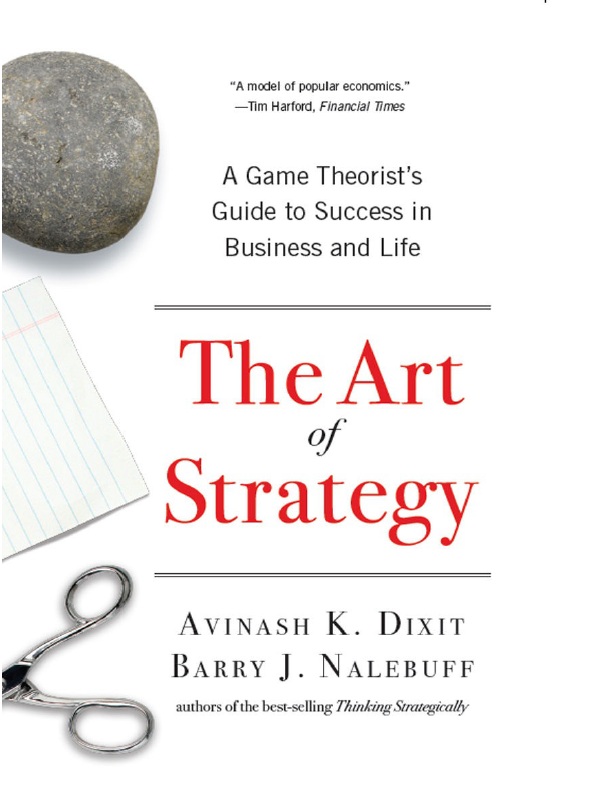
The Art of Strategy: A Game Theorist’s Guide to Success in Business and Life is a widely acclaimed book written by Avinash K. Dixit and Barry J. Nalebuff, two leading economists and pioneers in the field of game theory. First published in 2008 by W.W. Norton & Company, the book serves as a practical and accessible guide to applying game theory principles to everyday situations, ranging from business decisions and politics to personal choices and negotiations.
At its core, the book introduces readers to the concept of strategic thinking—the ability to anticipate others’ actions and responses in order to make smarter choices. By blending real-life examples, case studies, and clear explanations, the authors show how tools of game theory can be applied beyond economics, helping readers understand competition, cooperation, conflict, and decision-making in a complex world. The central idea is that by learning to “think strategically,” one can gain a powerful edge in business, careers, and personal life.
Lesson 1: Strategy Is Everywhere
Strategy isn’t just for generals or CEOs—it’s woven into everyday life. From guessing games to political reform, this chapter shows how strategic thinking helps us navigate complex situations. The key is to anticipate others’ actions and think several steps ahead. Whether you’re negotiating, competing, or cooperating, strategy gives you the edge. The stories here reveal how subtle choices can have outsized consequences, and how mastering strategy begins with recognizing its presence all around us.
Lesson 2: Think Backward to Move Forward
When facing sequential decisions, the smartest move is to start at the end. Backward reasoning—working from the outcome you want—helps you choose wisely at every step. This lesson teaches how to solve games by anticipating future reactions and adjusting your current choices accordingly. Whether planning a business strategy or playing chess, backward induction reveals the path to optimal outcomes. It’s not just about what you do—it’s when and why you do it.
Lesson 3: Cooperation Is Possible—even in a World of Self-Interest
The prisoners’ dilemma shows how rational individuals can end up in worse situations by acting selfishly. But repeated interactions, trust, and clever incentives can turn conflict into cooperation. This chapter teaches how to escape destructive cycles by aligning interests and building reputations. Whether in business, politics, or relationships, cooperation isn’t naïve—it’s strategic. The lesson: think long-term, and design systems that reward mutual benefit.
Lesson 4: Equilibrium Is Where Strategy Meets Stability
Nash equilibrium is the cornerstone of strategic analysis. It’s the point where no player has an incentive to change their strategy, given what others are doing. This chapter teaches how to identify and interpret equilibria in competitive settings. It’s not always the best outcome, but it’s the most stable. Understanding equilibrium helps you predict behavior, design better games, and avoid surprises. Strategy isn’t just about winning—it’s about knowing what others will do.
Lesson 5: Embrace Uncertainty—Use It Strategically
Sometimes, the best strategy is unpredictability. Mixed strategies—where you randomize your actions—can prevent opponents from exploiting you. This lesson shows how chance can be a powerful tool in sports, warfare, and negotiations. By calculating expected payoffs and embracing risk, you can turn uncertainty into advantage. The key is knowing when to be predictable and when to keep others guessing. Strategy isn’t just logic—it’s also probability.
Lesson 6: Change the Game Before You Play It
Strategic moves—like threats, promises, and commitments—can reshape the game itself. This chapter teaches how to influence others by altering their choices. Credibility is crucial: empty threats don’t work, but real ones do. Whether locking in a decision or signaling resolve, strategic moves give you control. The lesson: don’t just play the game—design it to favor your goals. Power lies in shaping the rules others must follow.
Lesson 7: Make Your Strategy Believable
A strategy is only as strong as its credibility. This chapter teaches how to make threats and promises stick through reputation, contracts, and public commitments. Bluffing may work once, but trust wins in the long run. The lesson here is about signaling seriousness and building reliability. Whether in business deals or diplomacy, your ability to influence depends on how believable you are. Strategy isn’t just about intention—it’s about perception.
Lesson 8: Use Information as a Weapon
Information is power—but only if used wisely. This lesson explores how to reveal, conceal, and interpret signals in strategic settings. From job interviews to poker games, what you know—and what others think you know—can shape outcomes. Screening and signaling help manage asymmetric information. The key is to control the narrative and read between the lines. Strategy thrives on insight, and insight comes from mastering information flow.
Lesson 9: Build Cooperation Through Repetition and Trust
Repeated interactions create opportunities for cooperation. This chapter teaches how strategies like tit-for-tat foster trust and discourage betrayal. Coordination problems can be solved through shared expectations and focal points. The lesson: relationships matter. In long-term games, reputation and consistency are more powerful than short-term gain. Strategy isn’t just about competition—it’s about collaboration when the stakes are ongoing.
Lesson 10: Win Smartly—Not Just Aggressively
Auctions and contests reveal how competition works under pressure. This lesson teaches how to bid wisely, avoid the winner’s curse, and understand different auction formats. Success depends on knowing your value, anticipating rivals, and timing your moves. Whether buying a company or winning a prize, strategy means more than just offering the highest bid—it’s about playing the game with insight and restraint.
Lesson 11: Negotiate with Strategy, Not Emotion
Bargaining is a strategic dance of offers, counteroffers, and concessions. This chapter teaches how to negotiate effectively by understanding incentives, timing, and credibility. Patience and preparation matter more than aggression. The lesson: successful negotiation isn’t about dominating—it’s about crafting deals that both sides can accept. Strategy turns conflict into agreement through thoughtful design and tactical empathy.
Lesson 12: Vote Strategically, Not Just Sincerely
Voting isn’t always straightforward—strategic voting can change outcomes. This lesson explores how different voting systems affect behavior and how individuals can manipulate their choices to influence results. Tactical voting, agenda setting, and coalition building are all part of the game. The key is understanding the rules and anticipating others’ moves. Strategy in voting means thinking beyond your first preference to achieve your best outcome.
Lesson 13: Design Incentives That Work
Incentives shape behavior—but only if they’re well-designed. This chapter teaches how to align individual goals with collective outcomes through rewards, penalties, and contracts. Poor incentives lead to cheating, shirking, or unintended consequences. The lesson: strategy isn’t just about playing the game—it’s about designing it so everyone plays better. Smart incentives create win-win scenarios and drive strategic success.
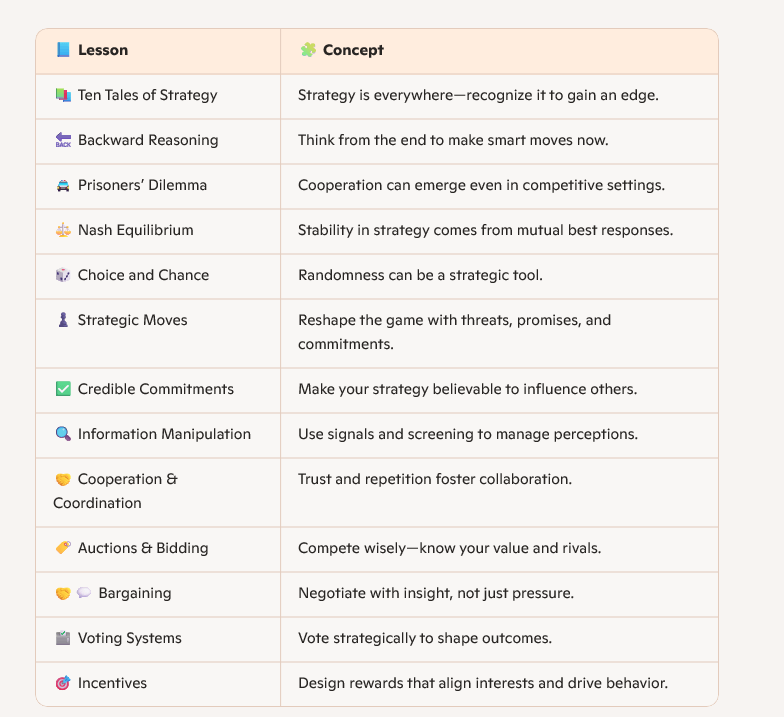
In conclusion, The Art of Strategy equips readers with a powerful lens to decode competition, cooperation, and conflict in all walks of life. By revealing how subtle shifts in choices can alter outcomes, it highlights the importance of foresight and adaptability. The book’s insights extend far beyond business, offering valuable lessons for personal growth, relationships, and everyday decision-making. Ultimately, it shows that mastering strategy is not about outsmarting others, but about thinking smarter yourself.
 Expressions and Impressions
Golden Rules for Smarter Decisions
LikeLiked by 1 person
Thank you for wonderful post
LikeLiked by 1 person
Beautifully narrated the core of all what the author wish to communicate to the readers. The very idea to navigate in the world of competition, selfishness and dominating the opponents, the book definitely takes us towards the path of optimism and hope.
LikeLiked by 1 person