Life rarely falls apart in one dramatic moment. More often, it slowly unravels through rushed mornings, neglected bodies, restless nights, scattered focus, and days that never truly end. Life often feels overwhelming not because we lack ability, but because our days lack rhythm. Routines bring that rhythm. They act like anchors in a fast-moving world; quietly holding us steady; not as rigid schedules, but as soft structures that hold us together. Routines give shape to our days, reduce mental clutter, and offer stability when life feels uncertain. They help us show up for ourselves consistently, even on ordinary days.
Routines are acts of self-respect. They remove the need to constantly decide, motivate, or push ourselves. Instead, they create flow. They don’t restrict freedom; they create space for it. When certain actions become automatic, our energy is freed for creativity, relationships, and meaningful work. The following five routines don’t aim to perfect your life: they aim to support it, gently and sustainably.
Routine One
A Morning Routine: Setting the Tone
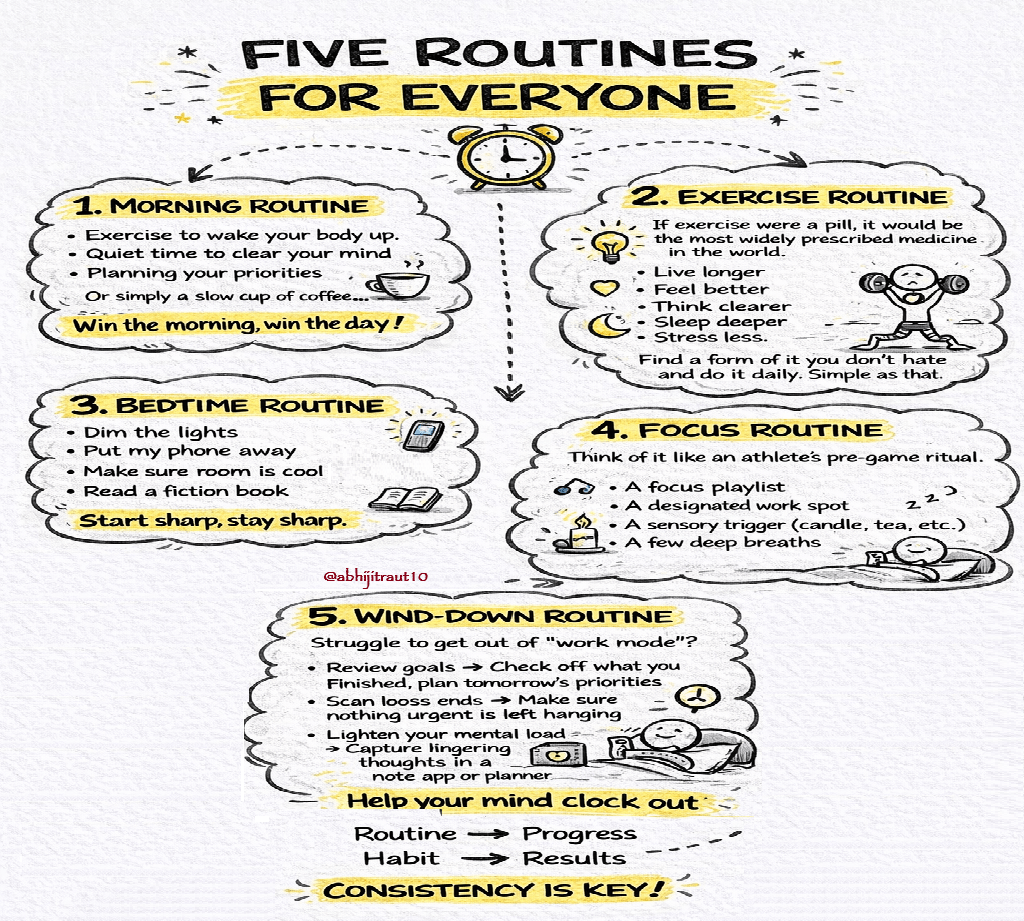
A morning routine is less about productivity and more about orientation. It helps you arrive into the day rather than being thrown into it. The way you start your morning quietly shapes the rest of your day. A good morning routine isn’t about waking up at 5 a.m. or following someone else’s formula. It’s about beginning with intention. The first few moments after waking are powerful; they set the emotional and mental tone for everything that follows. When mornings begin calmly, you start the day feeling grounded instead of reactive. This could mean stretching your body, sitting in silence, journaling a thought, or simply breathing before checking your phone.
What matters most is not what you do, but how it makes you feel. A good morning routine reminds you that the day belongs to you before it belongs to demands, deadlines, and notifications. Over time, this gentle start builds clarity and confidence. You begin the day feeling prepared rather than pressured, which changes how you respond to challenges for the rest of the day. These structured moments tell your mind: I’m ready. When mornings are gentle and purposeful, the day feels less reactive and more grounded.
Routine Two
An Exercise Routine: Moving for Life
Exercise is one of the simplest yet most powerful routines we can build. It helps us live longer, feel better, think clearer, sleep deeper, and manage stress more gracefully. Exercise is often framed as a tool for appearance, but its real gift lies in how it makes us feel. Regular movement improves mood, sharpens thinking, deepens sleep, and reduces stress. It reconnects us with our bodies in a world that often keeps us stuck in our heads. Even light movement like walking, stretching, yoga can shift your energy and reset your nervous system.
The magic of an exercise routine lies in consistency, not intensity. When movement becomes a daily habit rather than an occasional effort, it stops feeling like a task and starts feeling like care. Finding a form of movement you don’t hate and showing up daily, even briefly, is enough. If exercise were a pill, it would be prescribed to almost everyone. The key isn’t intensity: it’s consistency. Over time, movement becomes less about discipline and more about gratitude for what your body can do; and this routine becomes a quiet reminder: your body is not something to fix, but something to support.
Routine Three
A Bedtime Routine: Protecting Rest
Sleep is where healing happens. It’s when the body repairs itself, the mind processes emotions, and energy is restored. Sleep is not optional, it’s foundational. Yet in busy lives, sleep is often treated as an afterthought. How you spend the last hour before bed often decides the quality of your sleep. A bedtime routine protects this sacred space by slowing the transition from stimulation to rest. Dimming lights, reducing screen time, keeping the room cool, and engaging in calming activities signal to your body that it’s safe to relax.
More than physical rest, a bedtime routine offers emotional closure to the day. It helps you let go of unfinished thoughts and mental noise. When nights are calm, mornings feel lighter. Over time, better sleep improves patience, focus, and resilience. You don’t just wake up rested—you wake up more equipped to handle life. A bedtime routine gently closes the day, allowing your nervous system to slow down. Good sleep doesn’t just give you energy; it gives you patience, clarity, and emotional balance.
Routine Four
A Focus Routine: Entering Deep Work
Focus doesn’t appear on command; it needs preparation. A focus routine works like a mental doorway, guiding your brain into a state of deep attention. A pre-focus routine works like an athlete’s pre-game ritual, training your brain to switch into deep work mode. By repeating the same cues viz. music, a specific workspace, a cup of tea, a few deep breaths, you train your mind to associate these signals with concentration. This reduces resistance and makes starting work easier.
In a world full of distractions, focus becomes a skill worth protecting. A consistent pre-focus routine minimizes mental friction and allows you to work with clarity rather than force. Over time, you spend less energy trying to concentrate and more energy actually creating, thinking, and solving. Small signals tell your mind, Now we concentrate. Over time, focus becomes easier because your brain recognizes the pattern, and eventually focus becomes less exhausting and more natural.
Routine Five
A Wind-Down Routine: Ending the Day Well
Many people finish work but never truly leave it. Thoughts linger, tasks remain mentally open, and the mind stays in “work mode” long after the day ends. A wind-down routine creates a clear boundary between work and personal life. Reviewing what you’ve completed, planning tomorrow’s priorities, and capturing loose thoughts help your brain release the need to remember everything.
This routine isn’t about productivity: it’s about peace. It tells your mind that nothing important is being forgotten. When you consciously close the day, evenings become more present and restful. Saying “shutdown complete” may sound simple, but it’s powerful. It gives your brain permission to stop carrying unfinished business into the evening. Over time, this habit reduces anxiety, improves sleep, and brings a deeper sense of balance between effort and ease.
Individually, these routines may seem small. Together, they quietly transform life. A mindful morning brings direction, movement builds strength, sleep restores balance, focus deepens productivity, and winding down creates peace. These five routines don’t demand perfection; only presence. When practiced gently and consistently, they shape days that feel calmer, clearer, and more intentional. And over time, those days become a life that feels a little lighter, a little steadier, and a lot more fulfilling. Life doesn’t become easier, but it becomes steadier. In that steadiness, you find more clarity, more energy, and more space to live well. 🌿✨
 Expressions and Impressions
Leave a comment