Memorizing is not study but a better memory certainly helps. In competitive examinations and demanding academic journeys, understanding concepts is the foundation. However, the vast syllabus demands strong retention. Success depends not only on how much you study, but on how well you retain what you study. Memory is the bridge between effort and performance. You may spend hours reading and revising, yet without effective retention strategies, information fades when you need it the most. Improving memory is not about cramming facts; it is about training your brain to store, organize, and retrieve knowledge efficiently.
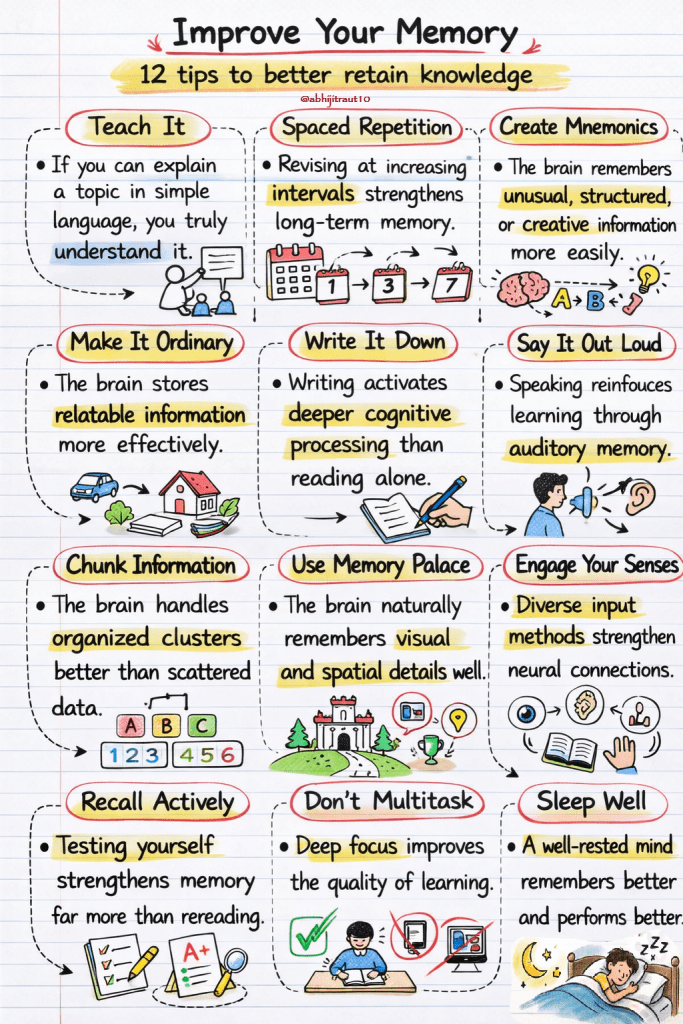
The article outlines twelve practical and research-backed techniques that make learning deeper and more durable. From teaching concepts and spaced revision to active recall and proper sleep, each method strengthens a different aspect of memory. Together, they form a simple yet powerful framework to help students convert understanding into lasting recall. When applied consistently, these strategies can transform preparation from stressful repetition into structured, confident learning.
1. Teach It
If you can explain a topic in simple language, you truly understand it. Teaching is one of the most powerful ways to strengthen understanding. When you try to explain a topic in simple language, you automatically organize your thoughts clearly. It forces you to identify gaps in knowledge and unclear areas. If something cannot be explained simply, it usually means it is not fully understood. Teaching also improves articulation, which is crucial for Mains and Interview. The process converts passive learning into active processing. It builds conceptual clarity and long-term retention.
For example, after studying Fundamental Rights, try explaining Article 19 to a friend or even to yourself as if you are teaching a school student. If you get stuck while explaining “reasonable restrictions,” that shows a gap in understanding. Teaching exposes weak areas and strengthens clarity which is crucial for Mains answers.
2. Spaced Repetition
Revising at increasing intervals strengthens long-term memory. Instead of revising everything repeatedly in one sitting, revisit topics after a gap. Each revision strengthens neural connections and reduces forgetting. Spaced revision prevents last-minute overload and anxiety. It ensures that information moves from short-term memory to long-term memory. Consistent revision cycles make recall faster during exams. This method is especially useful for factual and static portions.
If you study a detailed topic like Monsoon, you will remember only a little after a month without revision. Instead, revising one day after first reading, then after three days, then a week later, and again before the exam will help you retain the concept, and also it will help you understand it in a better way every time. This pattern helps long-term retention and avoids last-minute panic.
3. Create Mnemonics
Turn long lists into easy memory shortcuts. Mnemonics simplify complex or lengthy information into memorable patterns. The brain remembers unusual, structured, or creative information more easily. By converting lists into short phrases or acronyms, recall becomes faster. This technique is particularly useful for factual details and classifications. It reduces cognitive load during exams. Mnemonics act as triggers that unlock stored information. With practice, they make even large data sets manageable.
For example, to remember the famous mnemonic for remembering G20 countries is GURU JI SITA AB SSC FCI ME (Germany, USA, Russia, United Kingdom, Japan, India, Saudi Arabia, Indonesia, Turkey, Australia, Argentina, Brazil, South Africa, South Korea, Canada, France, China, Italy, Mexico, European Union). The stranger or more unique the mnemonic, the better you will remember it in Prelims.
4. Make It Ordinary (Relate It to Daily Life)
Connect new information with something familiar. This helps a lot to improve retention. When abstract concepts are linked to everyday understanding, they become easier to grasp. The brain stores relatable information more effectively. This method reduces confusion and enhances clarity. It also helps in writing better analytical answers. Familiar associations create stronger mental anchors. Over time, learning becomes more intuitive and less mechanical.
While studying inflation fluctuation in prices of essential commodities and Government’s response to it is an ideal case study. Real-life connections make abstract ideas easier to retain and explain in answers.
5. Write It Down
Writing improves memory and answer-writing speed. Writing activates deeper cognitive processing than reading alone. When you write, your brain organizes and filters information. It improves clarity, structure, and expression. The physical act of writing strengthens memory pathways. It also enhances answer-writing speed and precision. Regular writing practice builds confidence for descriptive exams. This habit transforms knowledge into exam-ready content.
Instead of just reading about the Directive Principles of State Policy, write them in short bullet points. Practice writing a 150-word answer on “Cooperative Federalism.” The act of writing strengthens recall and prepares you for the time pressure of Mains.
6. Say It Out Loud
Speaking reinforces learning through auditory memory. When you speak information, you process it differently than silent reading. It improves clarity of thought and communication skills. Verbal repetition strengthens recall under pressure. This technique also builds confidence for interviews and discussions. Hearing your own explanation reinforces understanding. It creates multiple memory cues for retrieval.
Economic Survey of India is released in February- nearly in the last leg of Interview (Personality Test). One method to cover it quickly is to read important points in it loudly in group. When you say it, hear it, and think about it simultaneously, memory becomes stronger. This is especially helpful for interviews as it also helps to deliver answers in a better way
7. Chunk Information
Breaking large information into smaller units makes it easier to remember. The brain handles organized clusters better than scattered data. Chunking reduces overwhelm and increases focus. It helps in systematic revision of vast syllabi. Smaller sections allow clearer conceptual mapping. This method also improves structured answer writing. Organized learning leads to faster recall.
Culture is one part which has lot of factual bits to remember. If you can club the facts regarding architecture, art forms, religion according to the historical time period, it will be easy to remember.
8. Use Memory Palace
Visualize information in familiar places. Visualization enhances memory by linking ideas to mental images. Placing information in imagined familiar spaces improves recall. The brain naturally remembers visual and spatial details well. This method creates strong associative memory pathways. It is especially helpful for retaining structured information. Mental mapping makes revision more engaging. Visualization strengthens long-term retention.
You can turn the Indian map itself into a memory palace by mentally walking across regions and linking vivid images from your house to geography concepts: imagine ice cubes in Jammu & Kashmir for glaciers, turbines in Himachal for hydropower, a kitchen full of wheat sacks in Punjab for agriculture, a sand-carpeted Rajasthan for deserts, spice jars in Kerala for biodiversity, and coconut palms in Lakshadweep for island ecology; this way, each state or region becomes a “room” holding a concept, and when you mentally traverse the map, the images trigger recall of rivers, soils, industries, climate zones, and biodiversity in a structured, exam-ready manner.
9. Engage Your Senses
Use multiple modes of learning. Using multiple senses while learning improves memory depth. Reading, listening, writing, and discussing create layered understanding. The more ways information is processed, the stronger it stays. Multi-sensory learning reduces monotony. It increases concentration and interest. Diverse input methods strengthen neural connections. This leads to more reliable recall during exams.
Read, listen to lectures, write notes, and discuss topics (not simultaneously!). For example, after reading about Climate Change, watch a documentary, draw a small diagram of the carbon cycle, and explain it to someone. The more senses involved, the stronger the retention.
10. Recall Actively
Testing yourself strengthens memory far more than rereading. Active recall forces the brain to retrieve stored information. Retrieval practice improves speed and accuracy. It identifies weak areas early. Regular self-testing builds exam temperament. It transforms knowledge into usable form. Active recall is one of the most effective memory tools.
After finishing a chapter on Medieval History, close the book and write down key rulers, policies, and cultural contributions. Attempt mock tests regularly. Active recall strengthens exam performance far more than passive reading.
11. Don’t Multitask
Deep focus improves the quality of learning. Multitasking divides attention and weakens retention. Concentrated study strengthens neural connections. Single-tasking increases productivity and reduces errors. It helps in understanding complex subjects better. Focused sessions improve efficiency. Quality of attention determines quality of memory.
Topics like Science and Technology often tempt us to go deep into the concepts, beyond the syllabus limits. Some topics also demand to watch a video about it while reading. Don’t get keep the book/notes aside till you are done reading. You can always go deep during leisure time, or watch video after you finish reading. Keep your phone away while studying. Deep focus helps your brain store information properly.
12. Sleep Well
Sleep plays a crucial role in memory consolidation. During rest, the brain organizes and stores information. Lack of sleep weakens concentration and recall. Proper rest improves cognitive performance. It enhances clarity and analytical ability. Sleep also reduces stress and mental fatigue. A well-rested mind remembers better and performs better.
This becomes even more important in exam period. Cramming numbers from Budget late at night just before the exam will not help. On the contrary, sleep well and your brain will recall things read long time back. Lack of sleep reduces concentration and recall speed. A well-rested mind performs better in both Prelims and Mains.
Preparation for UPSC CSE or any other competitive or academic examination is not about cramming facts; it is about understanding deeply and recalling clearly under pressure. Smart memory techniques reduce stress, improve answer quality, and build confidence. When understanding meets disciplined revision and structured recall, success becomes much more achievable.
Study wisely, revise consistently, and trust your preparation.
 Expressions and Impressions
This is such a powerful and practical breakdown of memory techniques. I love how it clearly connects understanding with retention, especially the emphasis on active recall and spaced repetition. These strategies can truly transform preparation from stressful cramming into confident, structured learning. A must-read for every serious aspirant!
LikeLiked by 1 person
its very helpful..
LikeLiked by 1 person