On 12 March 2006, at the iconic Wanderers Stadium, cricket witnessed a moment that redefined limits; not just in the sport but in terms of human psychology. What unfolded between the Australia national cricket team and the South Africa national cricket team during the 5 match series decider in the Australia tour of South Africa 2005–06 was not merely a match. It was a contest that altered how teams perceived the possible.
Before that day, 400 in ODI cricket seemed like a fantasy. By the end of the evening, the number had been breached twice.
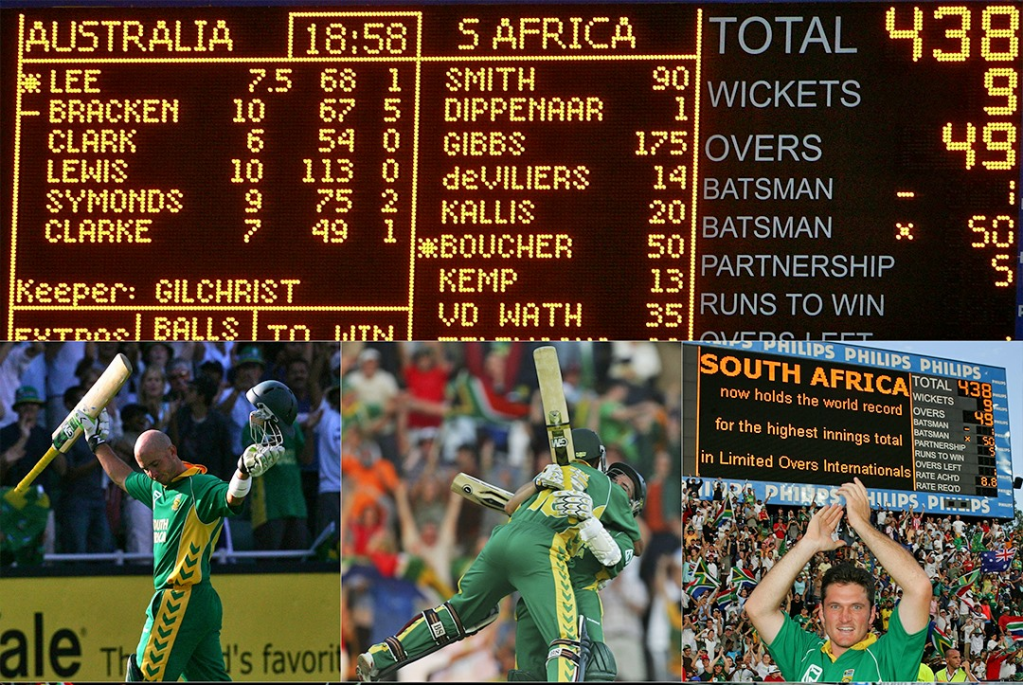
Image courtsey: Cricinfo @Getty Images
Australia won the toss and elected to bat on a featherbed pitch. Both sides were without their legendary pacemen (Shaun Pollock and Glenn McGrath) which perhaps tilted the balance toward the batters. Australia started aggressively, as they almost always did in that era. Adam Gilchrist and Simon Katich raced to 97 inside 16 overs, setting the tone early.
But the real show began after the first wicket. When Ricky Ponting walked in, the tempo of the innings changed dramatically. Ponting unleashed one of the finest innings of his career. It was a blazing display of authority and power. Australia pressed the accelerator further after Katich’s wicket. Michael Hussey and Andrew Symonds joined forces with Ponting to pummel the South African bowlers.
The acceleration was breathtaking. Australia more than doubled their score in the last 20 overs. Experienced campaigners like Makhaya Ntini and Jacques Kallis bore the brunt of the assault. When the innings ended at 434/4, it was the highest total ever scored in ODI cricket.
The general reaction across the cricketing world was simple:
It’s all over.
Many expected something like the one-sided dominance of the 2003 Cricket World Cup Final.
But South Africa thought otherwise.
A legend goes that Jacques Kallis told his teammates in the break that Australia were actually 10–15 runs short. Whether myth or reality, the message was clear: South Africa would not surrender. They decided to go for it.
The chase did not begin ideally. Boeta Dippenaar was dismissed cheaply. But then came a partnership that shifted the momentum. Graeme Smith and Herschelle Gibbs consolidated before launching a ferocious counterattack.
Smith was particularly brutal, smashing 90 off just 55 balls, attacking the Australian bowlers with fearless intent. Yet the innings truly belonged to Gibbs. He played an innings that remains one of the greatest in ODI history. He scored freely all around the ground, dismantling an Australian attack that included Brett Lee and Nathan Bracken.
His progression was astonishing: reaching 100 off 79 balls and 150 in the next 21 balls. The Wanderers erupted as Gibbs struck sixes and boundaries with astonishing ease.
But cricket rarely allows a straightforward script.
AB de Villiers fell cheaply. Soon after, Gibbs was dismissed for a magnificent 175 off 111 balls. Kallis and Justin Kemp followed to the dressing room shortly afterward. Suddenly, despite the remarkable fight, it seemed all over for South Africa. With only Mark Boucher remaining among the main batters, the equation read: 80 runs needed in 8 overs with four wickets remaining.
Against Australia, a side renowned for snatching victory from the jaws of defeat, the task looked formidable. After all, Australia had done it before: most famously in the 1999 Cricket World Cup Semi-final at Birmingham and the 1996 Cricket World Cup Semi-final at Mohali.
Enter Johan van der Wath. He played a fearless cameo, striking 35 off just 18 deliveries. His aggressive hitting reignited belief in the South African camp. Boucher remained calm and composed, guiding the chase closer to the target. Despite losing van der Wath, the game was suddenly within South Africa’s grasp with 13 runs needed from the last two overs and three wickets in hand. Australia, however, were not done.
Nathan Bracken produced a superb 49th over, picking up his fifth wicket and conceding just six runs to finish with an outstanding 5/67 in the middle of this batting chaos.The equation heading into the final over:
7 runs required to win.
The last over was pure theatre! Brett Lee took the ball for the final over. Mark Boucher took a single off the first ball, bringing Andrew Hall on strike. Hall, batting on 10 but experienced of playing in the top order, responded by hitting a boundary.
Now the equation was simple:
2 runs needed off 4 balls.
Lee charged in again and forced Hall into mistiming the next delivery straight to Michael Clarke.
Suddenly the drama escalated.
2 runs needed. One wicket remaining.
The number eleven, Makhaya Ntini, walked in to face one of the world’s fastest bowlers.
Anything could happen.
Ntini managed to take perhaps the greatest single of his life, celebrating as he ran through. The scores were level.
For a moment, the entire stadium froze. Proteas supporters began having flashbacks of the heartbreaking run-out in the 1999 World Cup semi-final when the scores were tied.
But this time, the ending would be different.
With remarkable calm, Mark Boucher drove the ball past mid-on for four.
South Africa: 438/9.
The miracle was complete.
History had been created.
No one had imagined two Test-status teams scoring 400 in the same match, forget chasing. Yet on that evening Australia scored a world-record 434 and South Africa broke that record four hours later.
But the most remarkable aspect was the mindset behind the chase. The South African thought process was simple: If they can score 434, we can too.
They did not overtry. They did not panic. They stuck to basics: building partnerships, waiting for bad balls, smart running between the wickets, and above all, belief.
This match was not just about numbers. It was about breaking a psychological barrier. Before that day, teams were content scoring 325-350. Teams chased totals cautiously, afraid of collapsing under pressure. After Johannesburg 2006, teams began to believe that no total was truly safe.
The match redefined not just the limits of cricket, but the limits of human belief under pressure.
And that is why, even today, the game at the Wanderers remains widely regarded as the greatest One Day International ever played.
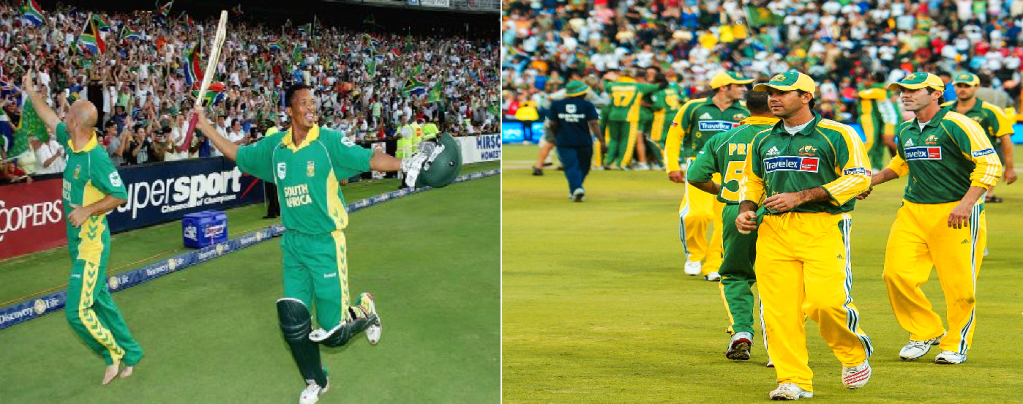
Image courtsey: Cricinfo @Getty Images
Match Summary
5th ODI, Johannesburg, March 12, 2006, Australia tour of South Africa.
Australia 434/4 (50) Ponting 164, Hussey 81. Telemachus 2/87.
South Africa (49.5) 438/9 Gibbs 175, Smith 90, Boucher 50*. Bracken 5/67.
South Africa won by 1 wicket (with 1 ball remaining)
 Expressions and Impressions
Leave a comment